

INTRODUCTION
Buying an electric car changes more than the way you drive. It also changes the way you think about keeping your car ready for the next journey.
For EV owners with a dedicated 7kW home wallbox, charging is relatively straightforward: arrive home, plug in and wake up with a replenished battery. But that setup simply isn’t available to everyone. Renters may not have permission to install a charger, some properties make installation difficult or expensive, and even those with a wallbox can benefit from having a portable backup sitting in the boot.
That’s exactly where the EVDANCE UK 3-Pin Portable EV Charger comes in.
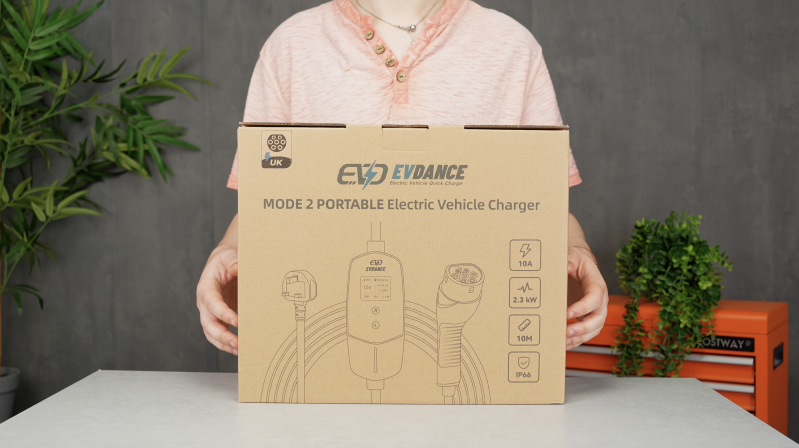
This is a single-phase, Type 2 portable charger designed to run from a conventional UK three-pin socket, with a maximum output of 10A or approximately 2.3kW. It’s what EV owners commonly refer to as a “granny charger”, but EVDANCE has tried to make it a considerably more reassuring proposition than some of the basic, inexpensive alternatives available online.
Alongside adjustable 6A, 8A and 10A current settings, there’s a real-time display, a delayed-start function and a substantial collection of built-in electrical protections. The version tested for this review also came with a particularly useful 10-metre cable, although a shorter version is available if you don’t need quite that much reach.
After using it as a practical alternative to faster home charging, the question isn’t whether it can compete with a 7kW wallbox — it can’t, and it isn’t supposed to. The more important question is whether it’s a portable EV charger you’d actually feel comfortable keeping in the boot and relying on when you need it.
QUICK SUMMARY
The EVDANCE Portable EV Charger is a well-built and refreshingly straightforward way of charging a Type 2 EV or plug-in hybrid from a UK household socket.
At up to 2.3kW, charging is inevitably slow compared with a dedicated wallbox, so anyone expecting rapid battery replenishment will be disappointed. Used in the right circumstances, however, that isn’t really the point.
Its appeal comes from flexibility. Adjustable 6A, 8A and 10A settings give you some control over the electrical load, while the delay timer is genuinely useful for overnight and off-peak charging. The display provides useful charging information without requiring an app, and EVDANCE has incorporated multiple safety protections alongside an IP66-rated design.
For renters, occasional charging, holidays or simply as an emergency backup for an existing wallbox, there’s a lot to like.

WHAT’S IN THE BOX
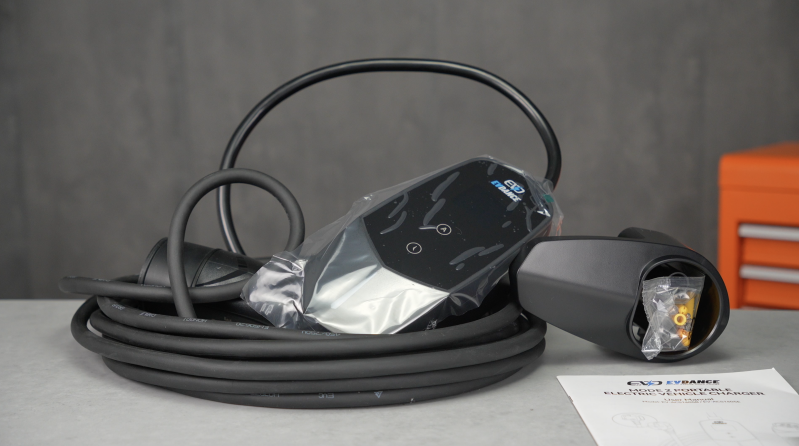
The package is refreshingly straightforward:
- EVDANCE portable Type 2 EV charger
- Carry/storage case
- User documentation and basic paperwork
- Warranty documentation
The carry case is particularly welcome because this is exactly the sort of charger that makes sense stored permanently in the boot. Rather than having a long cable and control box rolling around loose, everything can be packed away neatly when you’re finished.
DESIGN & BUILD QUALITY
First impressions are reassuring.
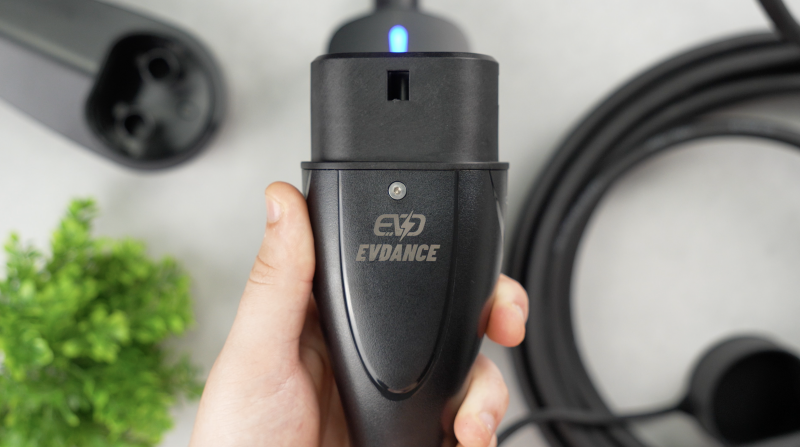
The charging cable feels thick and well insulated, while the Type 2 connector has a reassuringly solid construction. More importantly, the inline control unit doesn’t have the lightweight, flimsy feeling sometimes associated with inexpensive portable EV chargers.
It feels like equipment designed to be used rather than something that needs to be treated delicately.
EVDANCE says the cable uses high-purity copper conductors, while the connector incorporates silver-plated contacts intended to improve conductivity and connection stability. The manufacturer also quotes an operating temperature range of -30°C to 50°C, although for most UK owners the more relevant specification is the IP66 rating, providing protection against dust and water ingress suitable for regular outdoor use.
EVDANCE also makes some fairly substantial durability claims. According to the manufacturer, the cable has been tested through more than 10,000 bending cycles, while the cable housing is claimed to withstand loads of up to two tonnes.
Those aren’t claims we attempted to replicate — deliberately driving over your EV charging equipment isn’t something we’d recommend — but they do reinforce the portable, everyday-use positioning of the charger.
The model used for this review has a 10-metre cable, and that’s worth thinking about before ordering.
For many driveways, 10 metres is excessive. It’s more cable to unwind, coil and store every time you charge. In our particular setup, however, reaching from the garage to the vehicle meant that additional length was genuinely necessary.
EVDANCE also offers a shorter 6.1-metre version, which is likely to be the tidier option for buyers whose socket is relatively close to their parking space.
This is one situation where measuring the route from the socket to your car’s charging port before buying is definitely worthwhile.
SETUP & FIRST IMPRESSIONS
There’s very little setup involved, and that’s one of the EVDANCE’s strengths.
Connect the charger to the mains first and its display becomes the central point for configuring and monitoring the charging session. Rather than relying solely on a few coloured LEDs, you can see useful information such as charging status and live charging data directly on the unit.
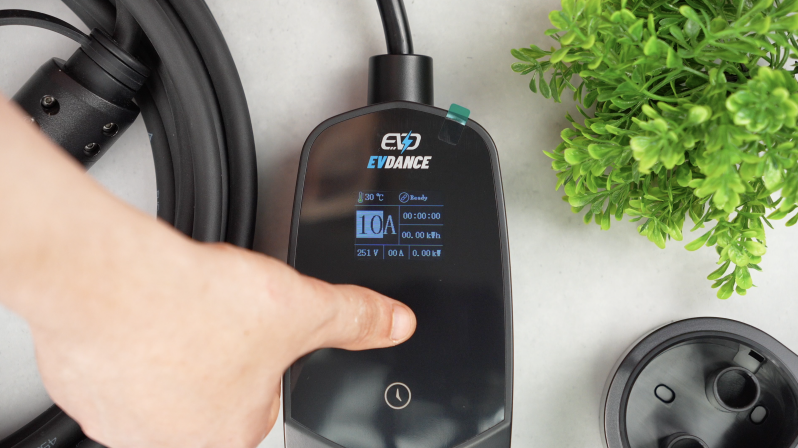
Before connecting the Type 2 plug to the vehicle, the charging current can be selected between 6A, 8A and 10A.
For most suitable installations, 10A provides the fastest available charging rate. Dropping to 8A or 6A reduces charging speed further but also lowers the electrical load, giving the charger useful flexibility when circumstances demand it.
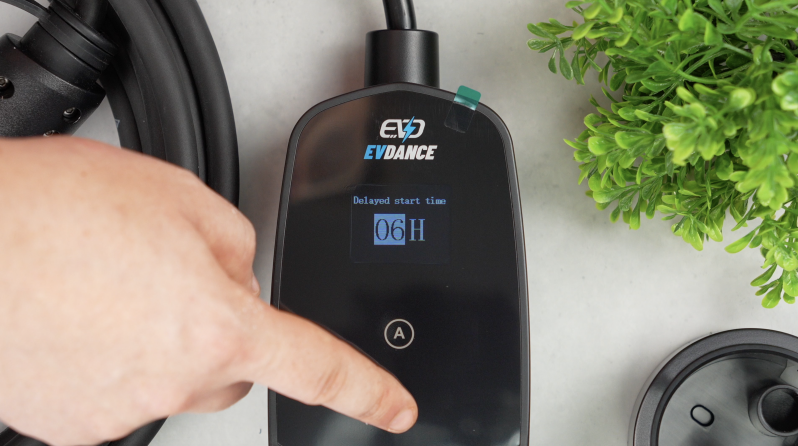
There’s also a delayed-start timer of up to 12 hours. This is one of the most practically useful features here, particularly for drivers with cheaper overnight electricity.
Instead of needing to walk outside late at night to connect the car, you can plug in when you arrive home and configure the charger to begin later.
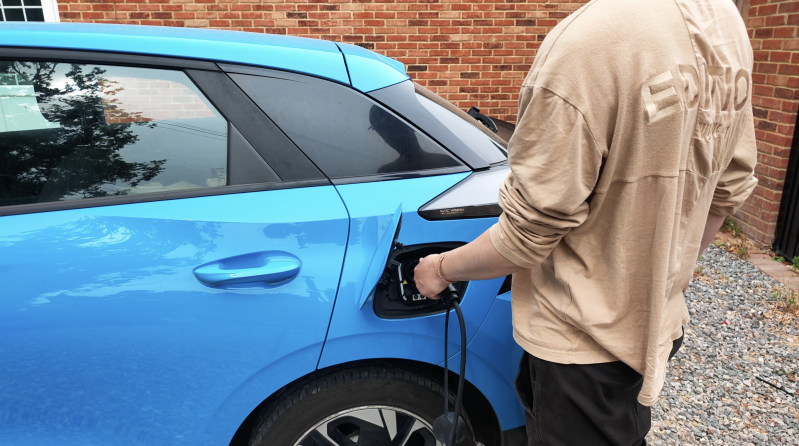
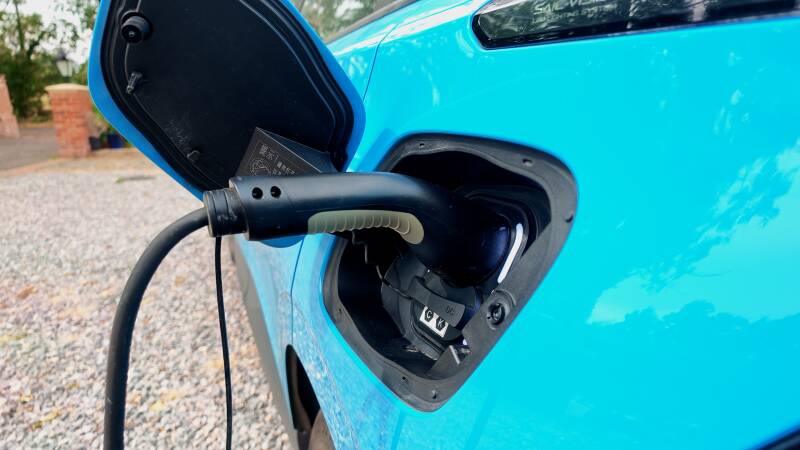
Once your settings have been selected, connect the Type 2 plug to the vehicle and charging can begin.
There’s no Wi-Fi configuration, Bluetooth pairing or companion smartphone app to worry about. Some buyers may see the lack of smart connectivity as a limitation, particularly if they’re accustomed to controlling a wallbox remotely, but it arguably suits this particular product.
A portable backup charger should be dependable and uncomplicated. Plug it in, select the required setting and charge the car.
FEATURES & PERFORMANCE
Adjustable 6A, 8A and 10A Charging
Being able to change the charging current is more useful than it might initially sound.
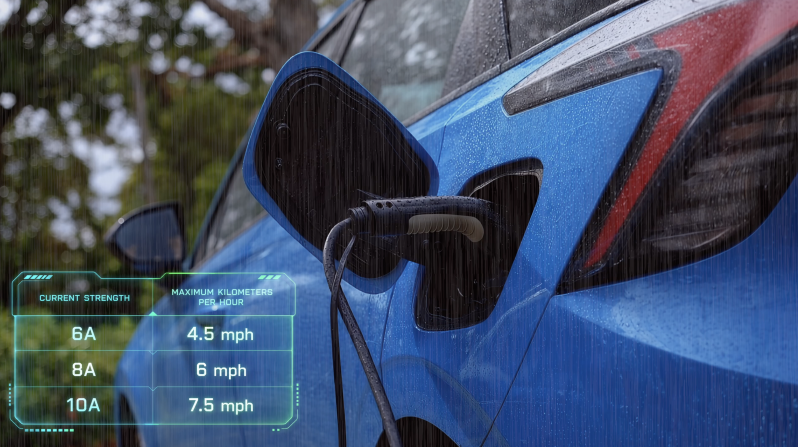
At the maximum 10A setting, EVDANCE quotes up to 2.3kW at 230V. Dropping to 8A reduces that theoretical output to approximately 1.84kW, while 6A brings it down to roughly 1.38kW.
The trade-off is straightforward: lower current means slower charging but a reduced electrical load.
One important point shouldn’t be overlooked here. A portable EV charger being limited to 10A does not automatically make every household socket suitable for prolonged EV charging. EVDANCE itself recommends an appropriate EV-rated socket and suitable electrical installation, and older or questionable wiring should be professionally checked.
That’s particularly important because EV charging can place a significant continuous load on a circuit for many hours.
Real-Time Display
The integrated display is another advantage over extremely basic portable chargers.
Charging an EV at 2.3kW can mean leaving it connected for a considerable period, so being able to glance at the control unit and see what is happening is genuinely useful.
It keeps the charger self-contained, too. There’s no need to find your phone, connect to Wi-Fi or depend on a cloud service simply to check the charging session.
Delayed Charging
The delayed-start function makes the EVDANCE much easier to integrate into an overnight charging routine.
You can postpone the start of charging by between one and 12 hours, making it possible to take advantage of an off-peak electricity window without needing smart connectivity built into the charger itself.
Owners should still check the exact times and conditions of their electricity tariff, but it’s a useful feature that gives this portable charger more flexibility than a simple plug-and-charge cable.
Type 2 Compatibility
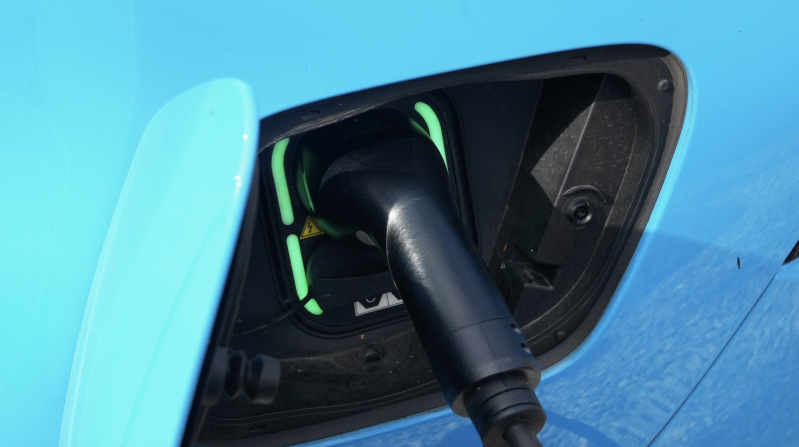
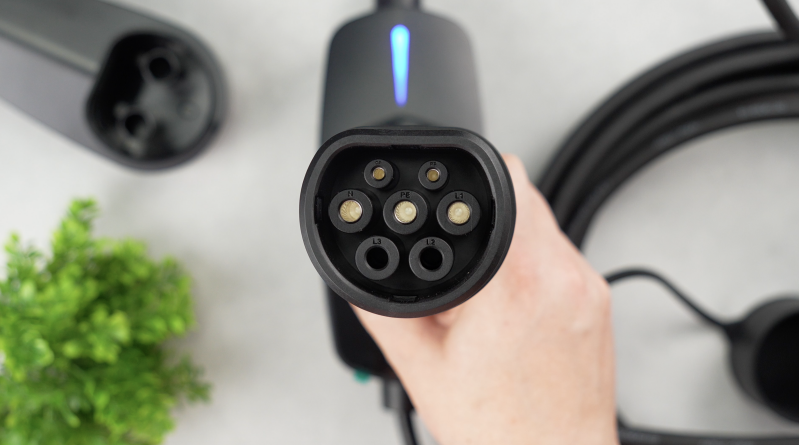
The vehicle end uses the widely adopted IEC 62196-2 Type 2 connector, making it suitable for a broad range of UK and European electric vehicles and plug-in hybrids equipped with Type 2 AC charging.
Vehicles fitted with a CCS2 charging inlet can also receive AC charging through the Type 2 portion of the connector. This is an AC portable charger, however, and should not be confused with DC rapid charging.
CHARGING SPEED
Charging speed is inevitably the EVDANCE’s biggest compromise.
At a maximum of around 2.3kW, this isn’t remotely comparable to plugging into a 7kW home wallbox, let alone using a public rapid charger.
Take an EV with a 60kWh battery. A simple theoretical calculation puts an empty-to-full charge at a little over 26 hours at 2.3kW, and real-world charging time can vary further according to the vehicle, charging losses, temperature, battery management and other conditions.
In other words, you don’t buy this because you want to recharge a large EV from empty in an evening.
A much better way of looking at it is range added overnight.
EVDANCE suggests up to approximately eight miles of range per hour, depending on the vehicle and conditions. Over a ten-hour overnight session, something approaching 80 miles could therefore be possible in favourable circumstances.
The actual figure will depend heavily on the efficiency of your car. A smaller, efficient EV may gain noticeably more useful driving range from each kilowatt-hour than a large, heavy electric SUV.
But even if the exact number varies, the underlying use case remains convincing.
If your daily commute is 30 or 40 miles and the car sits outside for ten hours every night, a portable 2.3kW charger may still replace the energy you’re using during an average working day.
That’s very different from being “fast”, but it can still be genuinely useful.
SAFETY
Safety is arguably more important than outright charging speed with a device that can remain connected to household mains electricity for many hours.
EVDANCE incorporates what it describes as a six-layer protection system, covering overcurrent, under- and over-voltage, leakage, overheating, grounding and short-circuit conditions. The manufacturer says the charger automatically cuts power when an abnormal condition is detected.
The Advanced version is also specified with PEN fault detection and AC leakage protection, adding another layer of reassurance for UK EV charging.
This is exactly the sort of technology you hope never becomes noticeable during ownership. Its purpose is to sit quietly in the background and intervene when something isn’t right.
There are still some basic rules owners shouldn’t ignore.
Most importantly, avoid using an extension lead. EVDANCE itself strongly discourages doing so, and a portable EV charger should ideally be connected directly to an appropriate, good-quality wall socket.
That also makes the choice between the shorter and 10-metre charger particularly important. If you need the extra reach, buying the longer charger is a much better solution than trying to bridge the distance with a conventional household extension lead.
It’s also worth periodically checking the socket and plug for signs of excessive heat, damage or discolouration, particularly during extended charging sessions. If you’re uncertain about the condition or suitability of the circuit supplying the socket, have it assessed by a qualified electrician.
The IP66 rating means the unit is designed to cope with dust and water exposure, making outdoor charging practical in typical British conditions. Even so, sensible precautions still apply: keep mains connections appropriately protected and don’t leave plugs or electrical connections sitting in standing water.
The overall message is that the EVDANCE has a reassuring collection of protective technology, but those protections don’t replace the need for a suitable electrical supply.
REAL-WORLD EXPERIENCE
The EVDANCE starts to make much more sense when you stop comparing it directly with a wallbox.
Imagine staying with relatives for several days. Instead of finding a public charger every time the battery gets low, having this cable in the boot potentially lets you add useful range overnight.
The same applies to holiday accommodation, provided the property owner permits EV charging and there’s an appropriate socket available.
It’s potentially even more valuable for renters.
Installing a dedicated home charger may involve obtaining permission from a landlord, paying installation costs and making a permanent change to a property you don’t own. A portable charger removes the permanent installation element.
For drivers whose mileage is relatively modest, slow overnight charging could therefore be enough to make home EV ownership significantly more convenient.
It’s also a sensible backup even if you already own a wallbox. Home charging hardware can fail, and knowing there’s another way of getting energy into the car could prevent an inconvenient trip to a public charger.
Portability matters in all of those situations, and that’s where the robust cable, carry case and straightforward controls work well together.
There are compromises.
A 10-metre cable becomes quite a substantial object when it’s wet and needs coiling back into the bag. Charging at 2.3kW requires patience. And owners wanting detailed smartphone monitoring, remote control or connected smart-home functionality won’t find it here.
But none of those shortcomings fundamentally undermine what the product is designed to do.
This is a relatively simple tool for getting electricity from an appropriate UK socket into a Type 2 EV, with enough additional control and safety technology to make the experience more reassuring than using the most basic portable charging cable you can find.
ROS
- Solid, reassuring construction
- Adjustable 6A, 8A and 10A charging current
- Up to 2.3kW output from a UK three-pin supply
- Useful real-time information display
- 1–12 hour delayed-start charging
- Extensive built-in electrical protection
- PEN fault detection specified on the Advanced model
- IP66-rated design for outdoor use
- Type 2 compatibility covers a broad range of UK and European EVs and PHEVs
- Long cable options are useful for awkward driveway layouts
- Carry case makes boot storage straightforward
- No app, account or wireless setup required
- Three-year manufacturer warranty
CONS
- 2.3kW charging is very slow compared with a dedicated 7kW wallbox
- A large EV battery can require well over 24 hours for a major recharge
- No Wi-Fi, Bluetooth or smartphone app for remote monitoring
- A 10-metre cable can be cumbersome if you don’t actually need the additional reach
- Requires a suitable, good-quality electrical socket and wiring for prolonged charging
- Not a replacement for a properly installed home wallbox for frequent high-mileage charging
- Users with questionable or older electrical installations should seek professional advice before relying on prolonged three-pin EV charging
WHO IS THIS FOR?
The EVDANCE makes the most sense for EV owners who value flexibility more than outright charging speed.
It’s particularly appealing for renters who cannot install a permanent wallbox, drivers who cover modest daily distances, and owners looking for an emergency charging solution to keep in the boot.
It’s also useful for regular travellers. If you frequently stay with family, visit holiday accommodation or spend time somewhere without dedicated EV charging infrastructure, having the ability to use a suitable UK socket can provide a useful safety net.
Owners with awkward parking arrangements should consider the 10-metre model, while anyone with a socket relatively close to the vehicle will probably find the shorter 6.1-metre cable easier to handle.
If you drive significant distances every day and have the option of installing a 7kW wallbox, however, that’s still the better long-term charging solution.
FINAL VERDICT
The EVDANCE UK 3-Pin Portable EV Charger doesn’t try to reinvent home EV charging, and that’s probably its biggest strength.
It’s a straightforward solution to a straightforward problem.
You get up to 2.3kW charging from a UK household supply, adjustable 6A, 8A and 10A settings, delayed charging, useful information on the integrated display and a reassuring collection of electrical safety protections. The cable and control unit feel suitably substantial, while the carry case makes it practical to keep everything stored in the boot.
Its biggest limitation is unavoidable: it’s slow.
If you’ve got a suitable location for a dedicated 7kW home wallbox and regularly need to replenish a substantial proportion of your battery, installing one remains the better solution.
But not everyone has that choice.
For renters, occasional users, travellers or anyone simply wanting a backup charging option, the EVDANCE fills an important gap. Leave an efficient EV connected overnight and even at 2.3kW, the range added may comfortably cover the following day’s commute.
And that’s ultimately the right way to judge it. This isn’t about replacing rapid charging or competing with a dedicated wallbox. It’s about having a portable, practical way of adding useful range when a conventional EV charger isn’t available.
With adjustable current, a long cable option, useful delayed charging and a safety-focused design, the EVDANCE delivers that experience convincingly.
Watch the full cinematic video review on the Gadget Crunch YouTube channel.
Product Link -
-
👉 Save 25% with code 25EVDcheckout
Add comment
Comments