

INTRODUCTION
Portable power stations are easy to dismiss—right up until the moment the electricity goes off.
For campers, content creators, van owners and anyone working away from the mains, they can quickly become essential. A dependable power station can keep a fridge cold, a router online, a laptop running and camera or drone batteries charged without the noise, fumes and maintenance that come with a petrol generator.
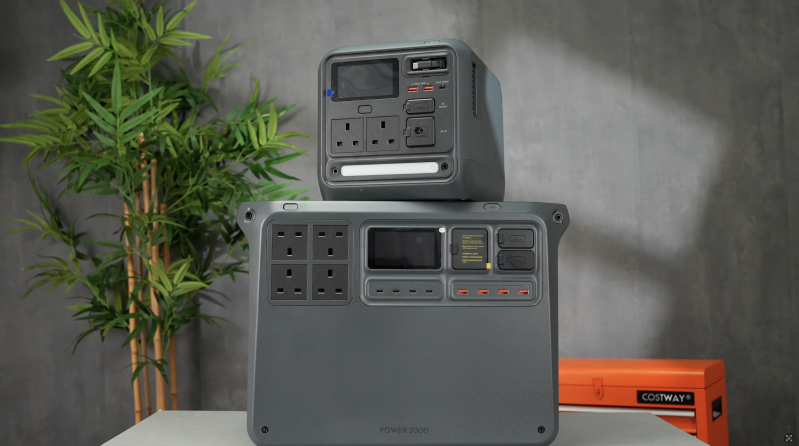
DJI now offers several models within its expanding Power range, but the DJI Power 2000 and DJI Power 1000 Mini represent two distinctly different approaches.
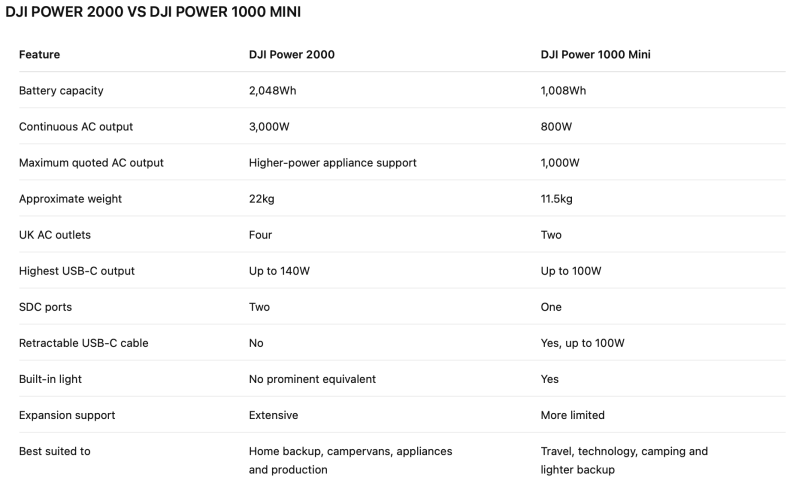
The Power 2000 is the heavyweight option. It combines a 2,048Wh battery with up to 3,000W of continuous AC output, making it suitable for demanding appliances, home-office backup, campervan installations and production equipment.
The Power 1000 Mini takes the opposite route. Its 1,008Wh capacity and 800W continuous AC output are more modest, but the entire unit is smaller, lighter and easier to move. It is designed less around running kettles and power tools, and more around keeping laptops, cameras, lighting, projectors and everyday technology alive.
They belong to the same family, but they are not simply large and small versions of the same product. One prioritises capability; the other prioritises convenience.
QUICK SUMMARY
The DJI Power 2000 is the stronger choice for home backup, larger camping setups, campervans, production crews and anyone who needs to operate high-wattage appliances. Its substantial battery, 3,000W output and expansion support make it genuinely versatile, although its 22kg weight and accessory-dependent ecosystem reduce its grab-and-go appeal.
The DJI Power 1000 Mini is considerably easier to live with. It still offers roughly 1kWh of storage, but packages it into a compact 11.5kg body with a retractable 100W USB-C cable, integrated lighting and useful charging options. Its 800W AC ceiling is the defining limitation, but for personal electronics and lighter backup duties, it is arguably the more practical machine.
WHAT’S IN THE BOX
DJI Power 2000
- DJI Power 2000 portable power station
- AC power cable
- Product documentation and safety information
DJI Power 1000 Mini
- DJI Power 1000 Mini portable power station
- AC power cable
- Product documentation and safety information
Neither package is especially accessory-heavy. Solar cables, specialist car-charging equipment, drone fast-charging cables, expansion batteries and many other optional extras are sold separately.
That matters when comparing the overall cost. The power stations are usable immediately for conventional AC and USB charging, but some of their most interesting off-grid and DJI-specific capabilities require additional hardware.
DESIGN & BUILD QUALITY
DJI Power 2000
The Power 2000 immediately feels like serious equipment.
Its design follows DJI’s familiar visual language: clean surfaces, tidy controls and a restrained finish that looks more like professional production kit than traditional camping hardware. Despite the amount of energy stored inside, its rectangular footprint remains reasonably compact and easy to position against a wall, beneath a workbench or inside a vehicle.
It is not, however, casually portable.
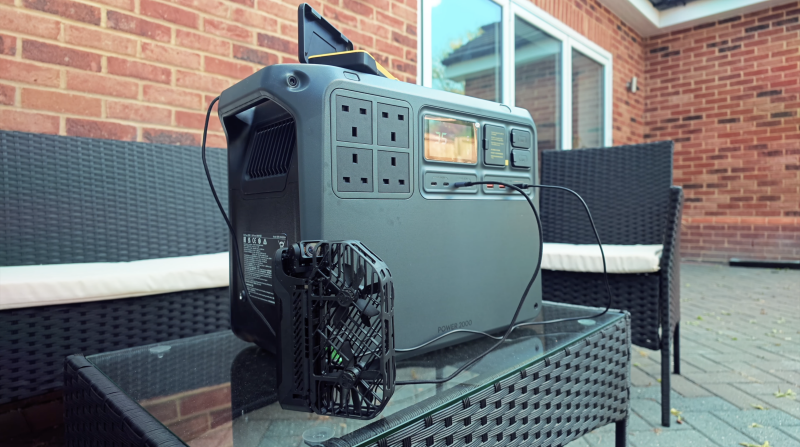
At approximately 22kg, it can be lifted into a car boot, repositioned around a house or carried a short distance at a campsite, but the weight becomes noticeable quickly. Large integrated handles make the job easier, although built-in wheels or a telescopic handle would have made far more sense for regular movement.
DJI offers a separate hand-truck solution, but incorporating some form of mobility into the station itself would have made the Power 2000 easier to live with straight out of the box.
Build quality is reassuringly solid. The casing feels substantial, the controls are clearly arranged and the overall construction gives the impression of a product designed for repeated transport rather than permanent placement in a living room.
DJI Power 1000 Mini
The Power 1000 Mini is much more approachable.
At around 11.5kg, it is still too heavy to treat like an ordinary power bank, but it can be carried comfortably over shorter distances and moved between rooms, vehicles and outdoor setups without becoming a two-person job.
Its compact dimensions make it easier to store beneath a desk, alongside a camera case, inside a campervan cupboard or near the front door ready for a trip. It feels less like a semi-permanent backup system and more like something that will genuinely travel with you.
Convenience has clearly shaped the design. The retractable USB-C cable removes one more item from the packing list, while the built-in light is useful around tents, vehicles and dark workspaces.
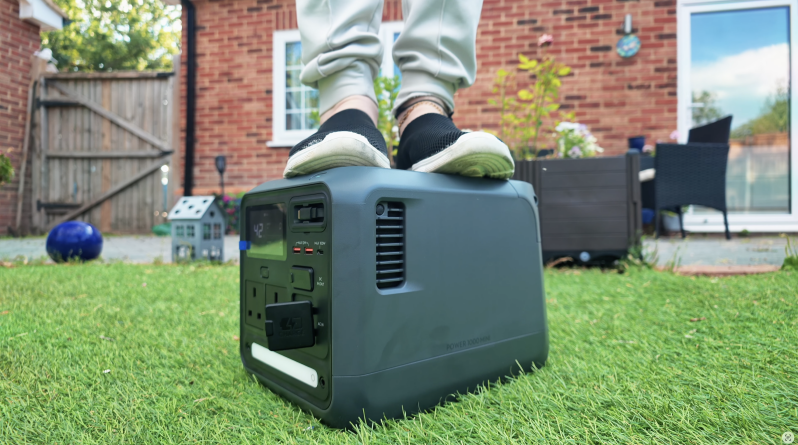
The casing also feels exceptionally rigid. During the source testing, the reviewer stood and jumped on top of the unit without producing obvious creaking or flex from the shell. That is not a recommended use and should not be interpreted as an invitation to use the station as a step, but it does demonstrate reassuring structural strength.
SETUP & FIRST IMPRESSIONS
Both power stations are straightforward to operate.
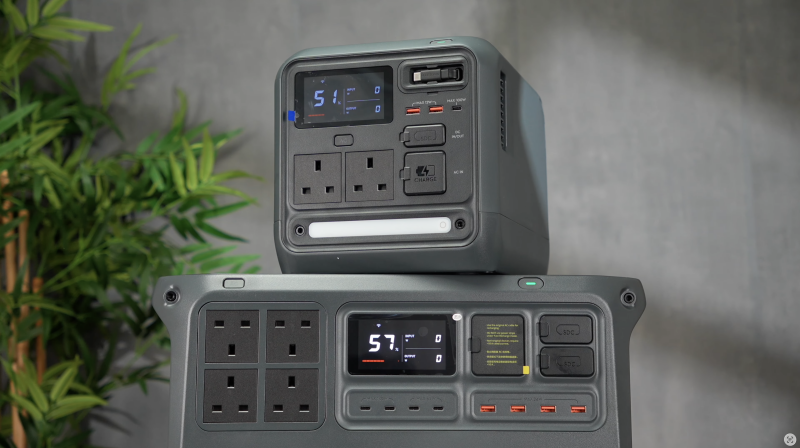
Charge the battery, switch the unit on and connect your equipment. The built-in display provides the most important information without requiring a phone, including:
- Remaining battery percentage
- Current input power
- Current output power
- Estimated operating time
- Active output status
That independence from an app is welcome. Basic power should never depend on creating an account, configuring Wi-Fi or installing software, particularly when the product may be used during an outage.
For more detailed control, both models can connect to the DJI Home app. From there, users can monitor power consumption, adjust selected charging behaviour, install firmware updates, configure automatic shut-off settings and create schedules or timers.
The app is useful rather than compulsory. Anyone who simply needs emergency power can largely ignore it, while more involved users can access additional configuration and monitoring.
Both units can also function as a form of uninterruptible power supply. When configured correctly and connected between the mains and compatible equipment, DJI states that they can begin supplying power within 0.01 seconds after an interruption. This makes them potentially useful for routers, desktop equipment and other devices that benefit from protection against brief outages, although suitability should always be checked for critical or unusually sensitive hardware.
FEATURES & PERFORMANCE
DJI Power 2000
Battery Capacity and AC Output
The headline figures are a 2,048Wh lithium iron phosphate battery and up to 3,000W of continuous AC output.
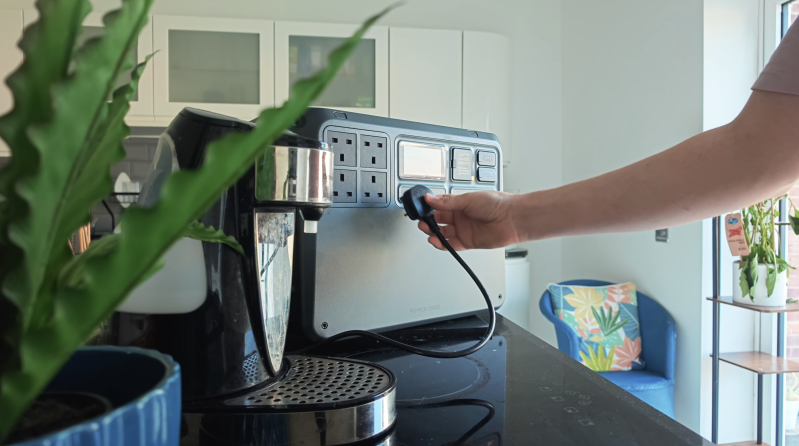
That output figure is important. Many smaller portable stations can keep electronics running but struggle as soon as a heating element, motor or powerful tool is connected. The Power 2000 can support a much broader range of equipment, including refrigerators, microwaves, kettles, coffee machines, air fryers, projectors, e-bike chargers and numerous power tools, provided their requirements remain within the station’s operating limits.
Its LFP battery chemistry is also designed for longevity. DJI rates the battery to retain more than 80 per cent of its original capacity after 4,000 complete charge cycles under specified laboratory conditions. Real-world ageing will vary with temperature, discharge load and storage habits, but the underlying chemistry is well suited to frequent use.
Ports and Connectivity
The UK version provides four AC sockets on the front, allowing several mains-powered devices to be connected at once.
USB connectivity is equally generous:
- Two USB-C ports supporting up to 140W each
- Two USB-C ports supporting up to 65W each
- Four USB-A ports
- Two DJI SDC ports
The 140W USB-C outputs are particularly valuable for modern performance laptops, while the 65W connections are suitable for tablets, cameras, compact notebooks and other everyday electronics.
The USB-A sockets remain useful for older charging cables, lights, wireless accessories and legacy devices.
DJI SDC Ecosystem
The two SDC ports are among the Power 2000’s most distinctive features.
With the appropriate DJI accessories, they can be used for high-speed car charging, solar input, expansion batteries, 12V equipment and fast charging for selected DJI drone batteries.
For creators already working with compatible DJI aircraft, direct fast charging in the field could be genuinely valuable. It reduces dependence on conventional charging hubs and may allow batteries to be turned around during a long filming day rather than requiring a large collection of spares.
The limitation is that SDC is proprietary. Many of these capabilities require specific DJI cables, modules or chargers, adding cost and reducing the convenience of mixing components from different brands.
Competing stations with conventional XT60 or other widely adopted solar connectors may feel more flexible for buyers who already own third-party panels and charging equipment.
Home-Office Runtime
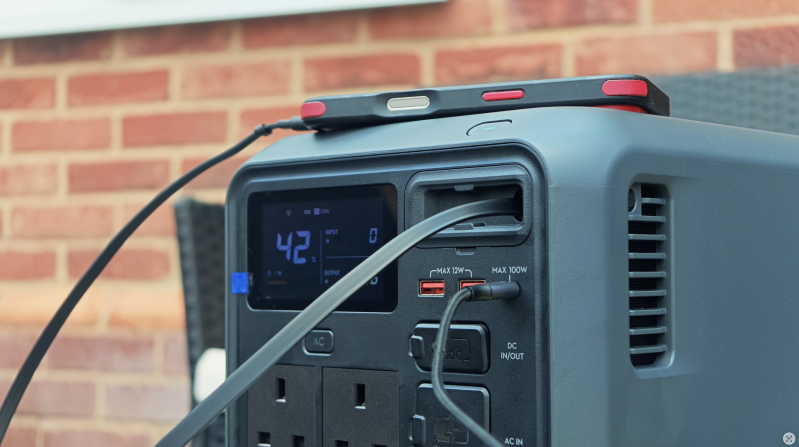
A typical mobile office containing a laptop, monitor, router, lighting and several chargers might consume somewhere between 100W and 250W, depending on the equipment and workload.
At a constant 200W load, the theoretical calculation from a 2,048Wh battery suggests slightly more than ten hours. In practice, AC conversion losses, background consumption and changing loads reduce that figure. The source testing estimated approximately eight to nine hours, which is still close to a full working day.
Lower-power setups could run considerably longer. Conversely, a workstation with a powerful desktop computer and multiple monitors would consume the battery more quickly.
High-Wattage Appliances
The Power 2000’s greatest advantage is not necessarily that it can operate high-wattage appliances continuously, but that it can handle them when they are needed.
A 2,000W kettle, for example, may draw heavily but only for a few minutes. If one boil consumes roughly 100Wh, a full battery could theoretically provide around 20 boils before conversion losses and reserve capacity are considered. A more realistic expectation would be approximately 16 to 18.
A microwave drawing around 1,000W to 1,200W may consume approximately 90Wh to 120Wh during a five-minute session. Short bursts therefore have a manageable effect on the battery, while continuous use would exhaust it far more quickly.
The same logic applies to heaters, hotplates, air fryers and high-powered tools. The Power 2000 can run them, but every minute at 2,000W represents a large portion of a 2,048Wh battery.
This distinction is central to understanding portable power stations: output determines whether an appliance can start and operate, while capacity determines how long it can continue.
Recharging
AC charging is one of the Power 2000’s strongest areas. DJI advertises rapid mains recharging, although the quoted time can vary by region, charging mode and local power limits. DJI’s UK material states that the battery can reach approximately 80 per cent in around 55 minutes under specified conditions.
That is impressive for a battery of this size. It means the station can be replenished during a relatively short stop rather than requiring most of a day on the mains.
Solar charging is also supported, as is high-speed vehicle charging through compatible accessories. However, the full off-grid potential is tied to DJI’s optional SDC modules and cables. The result is powerful but not always as simple as connecting a generic panel directly to a standard input.
Expansion and Home Backup
Expansion is where the Power 2000 becomes much more than a weekend camping battery.
Compatible expansion batteries can increase the total system capacity substantially, with DJI advertising configurations of up to 22,528Wh. At that scale, the system moves towards extended household backup, production support and larger off-grid installations.
Expansion increases the investment and physical footprint, but it provides a clear upgrade path. Buyers can begin with the standalone unit and add capacity later as their needs grow.
DJI Power 1000 Mini
Battery Capacity and Output
The Power 1000 Mini contains a 1,008Wh LFP battery and provides 800W of continuous AC output, with a quoted maximum of 1,000W.
That is enough for laptops, monitors, routers, phones, cameras, drone batteries, lighting, compact projectors, cool boxes and smaller fans. It is not enough for many kettles, heaters, air fryers, hairdryers or larger power tools.
The output ceiling must therefore be considered before buying. The battery holds enough energy to support a useful work or camping setup, but the inverter is deliberately designed around lighter loads.
Like the Power 2000, DJI rates its LFP cells to retain more than 80 per cent capacity after 4,000 cycles under controlled test conditions.
Ports and Built-In Cable
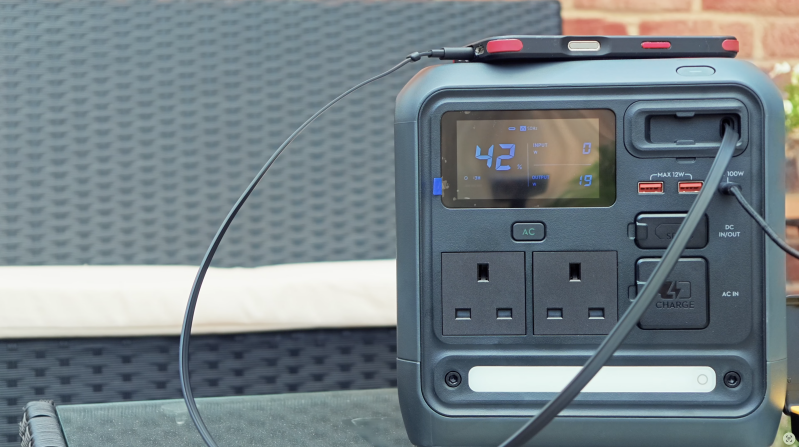
The UK model includes two AC outlets alongside USB-A, USB-C and one SDC connection.
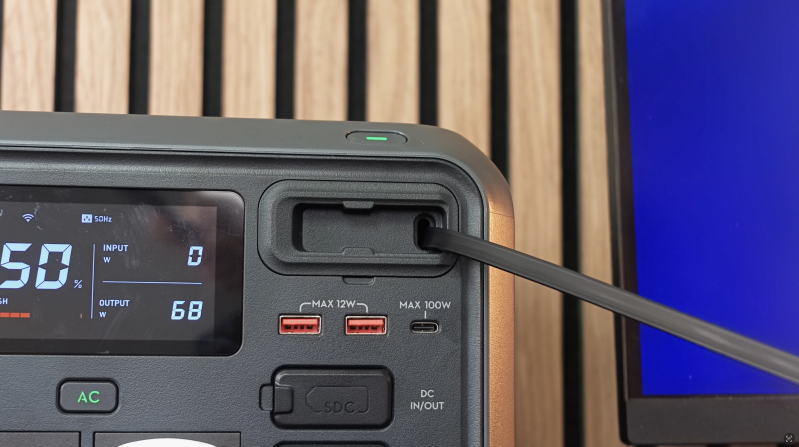
Its most convenient feature is the integrated retractable USB-C cable, which can deliver up to 100W. For many laptops, tablets and handheld devices, that eliminates the need to pack a separate cable.
The cable retracts neatly into the body after use, keeping the front of the station tidy and preventing loose leads from disappearing into bags or vehicles.
There is a limitation: some larger laptops can accept 140W, 180W or more over USB-C. Those machines will still charge at up to 100W when compatible, but they may not reach their fastest supported rate and could slowly lose charge during particularly demanding workloads.
For mainstream ultrabooks, tablets, phones, cameras and gaming handhelds, 100W remains highly useful.
Built-In Car Charger and Solar Controller
Unlike the larger model’s greater reliance on external charging modules, the Power 1000 Mini incorporates a 400W car-charging system and a 400W MPPT solar controller.
The appropriate cables are still required, but integrating the charging electronics into the station makes it a cleaner proposition for road trips and camping.
It can draw energy directly from a compatible vehicle setup, accept supported solar input and also recharge through USB-C at up to 100W. USB-C charging is comparatively slow for a 1,008Wh battery, but it provides a useful fallback when the mains or specialist charging cables are unavailable.
Runtime in Everyday Use
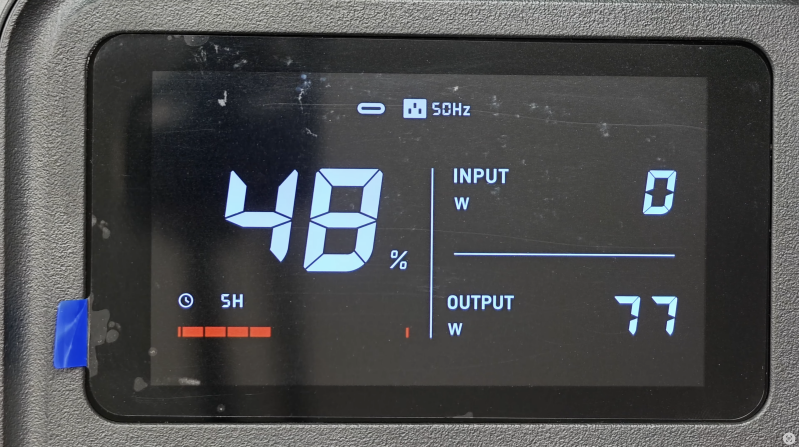
At a steady 100W draw, the battery offers just over ten hours in a perfect theoretical calculation. Allowing for inverter inefficiency and the station’s own consumption, the source testing suggested roughly eight to nine hours in typical use.
That could cover a conventional working day with an efficient laptop, monitor and router, or several evenings of modest lighting and device charging.
It is also well suited to camera production. A combination of battery chargers, compact lights, a laptop and a display can remain beneath the 800W limit while benefiting from a full kilowatt-hour of stored energy.
Problems begin when equipment exceeds the inverter’s capabilities. A 1,200W appliance will not simply run for less time—it may be rejected entirely because the required output is above the station’s supported range.
Recharging
DJI claims a 0-to-80 per cent AC recharge in approximately 58 minutes under suitable conditions.
That makes the Power 1000 Mini practical for regular travel. A substantial portion of the battery can be recovered during lunch, while packing equipment or during a short stop at a powered campsite.
Solar, vehicle and USB-C charging provide useful alternatives. Their actual speed depends on the available input, cable, sunlight, vehicle configuration and selected charging settings.
REAL-WORLD EXPERIENCE
The Power 2000 makes the strongest case when electricity is part of the infrastructure rather than an occasional convenience.
In a home office, it can keep the router, display, laptop and lighting operating through an outage without pushing close to its output limit. In a campervan, it could support cooking appliances, cooling equipment, chargers and entertainment systems without requiring a complex permanent electrical installation.
For creators, the combination of high-output USB-C, multiple AC sockets and DJI drone charging support is especially compelling. A production team could operate laptops, lights, monitors, battery chargers and selected high-draw equipment from one central unit.
Its weight is the main practical obstacle. You will probably decide where it needs to go before moving it, and frequent transport may encourage the purchase of a trolley or dedicated storage position.
The Power 1000 Mini is much easier to incorporate into everyday routines.
It is small enough to live beneath a desk and light enough to carry to the car without turning the journey into a workout. It feels appropriate for camping weekends, location photography, outdoor screenings, road trips and emergency internet backup.
Its retractable cable is a small addition that makes a noticeable difference. When the objective is simply to open the boot, connect a laptop and begin working, having a 100W cable permanently available removes friction.
The built-in light is similarly practical. It will not replace a dedicated campsite lighting system, but it can illuminate connections, help locate equipment during an outage or provide basic visibility inside a vehicle.
The trade-off is simple: it cannot handle many of the appliances people instinctively associate with backup power. Buyers who expect to run a kettle, portable heater or air fryer may find the 800W limit restrictive.
The choice is not simply a question of buying the largest battery available.
Choose the Power 2000 when the equipment must dictate the power station. Choose the Power 1000 Mini when portability dictates the equipment you intend to connect.
PROS
DJI Power 2000
- Strong 3,000W continuous AC output
- Can operate many household appliances and power tools
- Large 2,048Wh battery
- Four AC sockets and extensive USB connectivity
- Two USB-C outputs supporting up to 140W
- Fast mains recharging for its capacity
- Supports expansion batteries
- Useful DJI drone fast-charging options
- Straightforward operation without the app
- Durable LFP battery chemistry
- Suitable for home-office backup and UPS-style use
DJI Power 1000 Mini
- Considerably smaller and lighter than the Power 2000
- Useful 1,008Wh battery capacity
- Retractable 100W USB-C cable
- Built-in light
- Integrated car-charging and MPPT solar hardware
- Strong build quality
- Fast AC recharging
- Ideal for laptops, cameras, drones and portable workspaces
- Easy to store under a desk or inside a vehicle
- App is optional for basic operation
- Durable LFP battery chemistry
CONS
DJI Power 2000
- Heavy at approximately 22kg
- No integrated wheels or telescopic handle
- Most specialist accessories are sold separately
- Proprietary SDC connections may feel restrictive
- A complete solar, vehicle or expansion setup can become expensive
- High-output appliances still drain the battery rapidly
- More capacity than many casual users genuinely need
DJI Power 1000 Mini
- The 800W continuous AC limit rules out many household appliances
- Too heavy to carry in a backpack despite the Mini name
- Its 100W cable cannot provide maximum charging speed to some high-performance laptops
- Specialist SDC cables and accessories may add to the price
- Only two UK AC outlets
- Less suitable for comprehensive household backup
- USB-C recharging is useful but slow compared with AC charging
WHO IS THIS FOR?
Choose the DJI Power 2000 if:
You need to operate refrigerators, microwaves, kettles, tools or other demanding equipment.
It is also the more appropriate choice for a large home office, campervan, extended off-grid setup, production crew or expandable backup system. DJI drone operators who want rapid field charging may find its SDC support particularly useful.
It suits buyers who value output and capacity more than easy portability.
Choose the DJI Power 1000 Mini if:
Your priority is powering technology rather than heating appliances.
It is a strong match for photographers, drone pilots, remote workers, campers and road-trippers carrying laptops, phones, cameras, lighting, routers, projectors and cool boxes.
It is also better for anyone who expects to move the station regularly. The 11.5kg weight is still substantial, but it is far more manageable than the Power 2000.
FINAL VERDICT
The DJI Power 2000 and Power 1000 Mini solve different versions of the same problem.
The Power 2000 is the more capable machine by a considerable margin. Its 3,000W output allows it to power equipment that the smaller model cannot even start, while its 2,048Wh battery and expansion support make it a serious option for home backup, campervans and professional production.
That capability comes with predictable compromises. It is heavy, expensive once accessories are added and less convenient to move than its compact shape initially suggests.
The Power 1000 Mini is less ambitious, but potentially more useful for a larger number of people. Its 800W output demands realistic expectations, yet its 1,008Wh battery remains substantial for laptops, communication equipment, cameras, lighting and other electronics. The retractable USB-C cable, integrated light and manageable body make it the station you are more likely to take with you rather than leave at home.
For demanding appliances and longer backup scenarios, the Power 2000 is the clear winner.
For travel, camping, content creation and everyday technology, the Power 1000 Mini is the easier recommendation.
The Power 2000 is about capability. The Power 1000 Mini is about portability. Neither is universally better—the right choice depends entirely on what you plan to plug into it.
Watch the full cinematic video review on Gadget Crunch’s YouTube channel.
Add comment
Comments