

INTRODUCTION
Working from home sounds simple until you start noticing how much is quietly running in the background all day. A monitor here, a laptop charger there, the router, desk lights, tablets, camera batteries, drone batteries, phone chargers — and in the darker UK months, it all starts to feel like one long trickle of electricity.
The EcoFlow DELTA 3 Max is not some magical fix for rising energy bills, and it should not be treated like one. But as a practical way to power a home office, prepare for outages, charge during cheaper periods, or build a small solar-assisted setup, it starts to make a lot more sense than you might expect.
This is a 2048Wh portable power station designed for people who want proper capacity without stepping into a complicated installed home battery system. It sits in that useful middle ground between smaller camping-style power banks and the much larger, more expensive whole-home backup solutions. For a desk setup, creator workspace, campervan, garage, small off-grid cabin or emergency home backup, it has the numbers to be genuinely useful.
The question is not simply whether it can power things. It absolutely can. The more interesting question is whether it feels practical enough to live with day to day — and whether it is worth owning as something that becomes part of your setup, rather than just an emergency box that sits in a cupboard until the lights go out.

QUICK SUMMARY
The EcoFlow DELTA 3 Max is a powerful, well-built and surprisingly useful 2kWh portable power station that works especially well for home office use. In a typical work-from-home setup with a MacBook Air, monitor, router, desk light, iPad and smaller charging accessories, it can comfortably cover a full working day with plenty of battery left over.
Its biggest strengths are the generous 2048Wh capacity, strong AC output, fast mains charging, useful display, good app control and the flexibility to run everything from desk equipment to higher-wattage household appliances. It feels like a serious bit of kit, and for anyone dealing with outages, campervan power, garage use or energy-shifting from cheaper tariffs, it has clear appeal.
That said, it is not perfect. It is heavy, fairly expensive, and the standard DELTA 3 Max has a lower solar input than the Max Plus model. The screen could be easier to read from a distance, the box contents are quite minimal, and buyers need to be realistic about runtime when using power-hungry heat-based appliances like kettles, microwaves or hairdryers.
Overall, the DELTA 3 Max is a very capable power station, but it makes the most sense when you understand exactly what it is: a serious portable battery for running important gear, reducing reliance on the wall socket in smaller ways, and giving you proper backup power without installing a full home battery system.

WHAT’S IN THE BOX
EcoFlow keeps the unboxing fairly minimal here. Based on the supplied review script and EcoFlow’s product information, the package is focused mainly on the power station itself rather than a large bundle of extras.
Inside the box, you can expect:
- EcoFlow DELTA 3 Max portable power station
- AC mains charging cable
- User paperwork / documentation
Depending on the bundle purchased, EcoFlow also offers versions with accessories such as portable solar panels or extra battery options. However, for the standard “No Accessory” version, this is very much a straightforward package.
For the asking price, it would have been nice to see a storage bag, protective cover or a wider selection of cables included. EcoFlow is not alone here — plenty of brands have moved towards cleaner, more minimal packaging — but when you are spending this sort of money, a few extra practical accessories would have made the package feel a little more complete.

DESIGN & BUILD QUALITY
The first thing you notice about the DELTA 3 Max is that it feels substantial. This is not a small power bank with a handle stuck on top. It is a proper 2kWh power station, and physically it feels every bit as serious as that sounds.
The standard DELTA 3 Max weighs around 20.3kg, while the DELTA 3 Max Plus is slightly heavier at roughly 22.1kg. That means it is technically portable, but not casually portable. You can move it from room to room, lift it into a car, slide it beside a desk or take it into a campervan, but you are not going to be carrying it around all day like a smaller River-series unit.
That is not necessarily a flaw, because the capacity has to live somewhere. A 2048Wh LFP battery, inverter, cooling system, sockets and electronics will always come with weight. But it does mean buyers need to be honest about their use case. If you want something you can easily carry to a café, a campsite pitch or a photography location on foot, this is probably too much. If you want something that sits under a desk, in a van, in a garage, next to a router, or in a home backup corner, the weight feels much more reasonable.
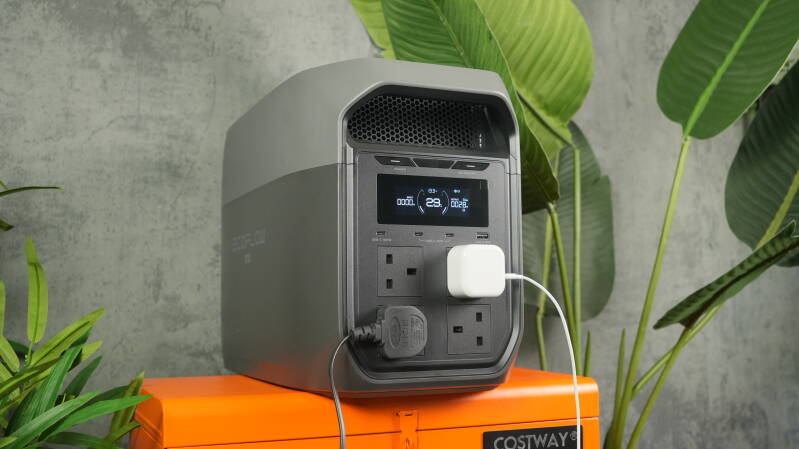
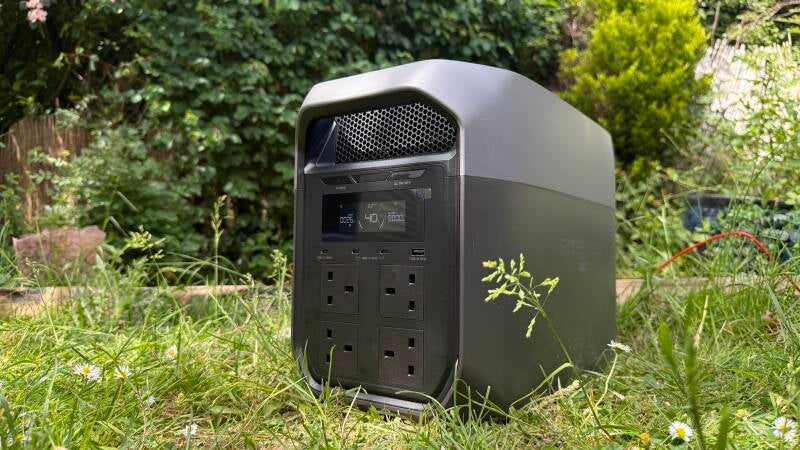
Visually, EcoFlow has kept the design clean and functional. The unit has a modern, slightly industrial look, with enough polish to sit in a home office without looking like a building-site tool. The front is where most of the daily interaction happens, with the display, AC sockets, USB ports and output controls all easily accessible.
The handles are integrated into the body rather than feeling like an afterthought, which helps when moving it around. The shape is boxy, but sensible. It is not trying too hard to be stylish, and that is probably the right decision. This is a product that needs to feel dependable more than decorative.
Build quality feels solid, and EcoFlow’s use of LFP battery chemistry is a major reassurance for long-term ownership. LFP batteries are generally favoured in this category because they offer better cycle life and improved thermal stability compared with older lithium-ion chemistries. EcoFlow also promotes its battery management system and full-tab LFP cell design on the DELTA 3 Max series, which is aimed at durability, heat management and long-term reliability.
In simple terms, this feels like a product built to sit there quietly, get used regularly, and not feel fragile while doing it.
SETUP & FIRST IMPRESSIONS
Setup is refreshingly simple. You unbox the unit, plug it in, charge it, turn on the outputs you need, and start using it. There is not a complicated installation process, and that is one of the biggest advantages of a portable power station compared with a more serious home battery or hard-wired backup system.
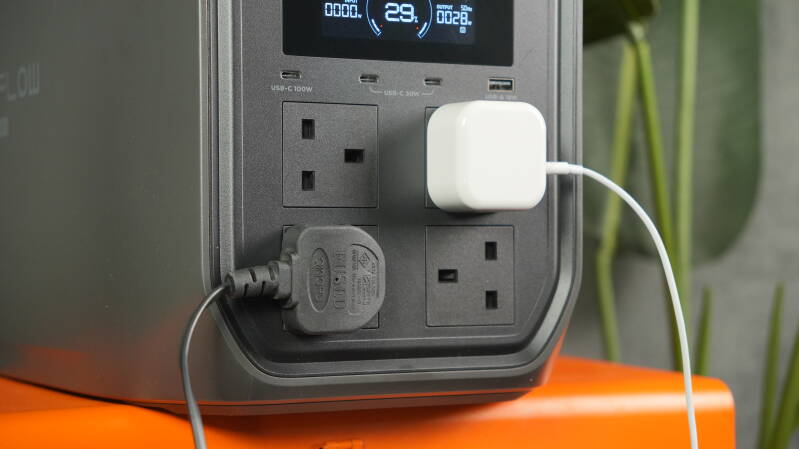
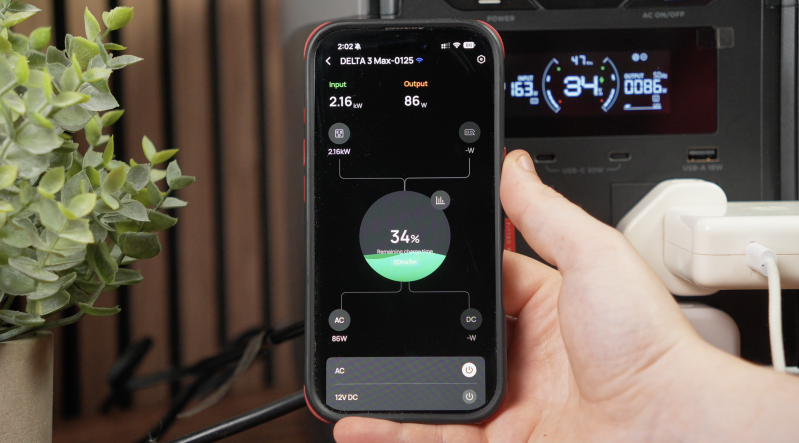
For basic use, you do not even need the app. The front display gives you the essential information immediately: battery percentage, input wattage, output wattage and estimated time remaining. That matters more than it sounds, because once you start powering a desk from a battery, you quickly become interested in what everything actually consumes.
A MacBook and monitor setup may look modest, but once you add a router, lamp, iPad, camera batteries, drone chargers and a few smaller accessories, you start to understand your day-to-day electricity use in a more visible way. The DELTA 3 Max makes that easy because the numbers are right there on the front.
The controls are also sensibly laid out. AC and DC outputs can be switched on or off, and the display icons update clearly, so you can see what is active. It avoids that slightly annoying problem some power stations have where you are never fully sure whether a port group is awake, asleep or wasting power in standby.
The one small criticism is the display size. It is clear enough when you are close to the unit, but if the DELTA 3 Max is sitting on the floor beside or under your desk, you may find yourself leaning down to read the smaller figures. It is not unreadable, and it is not a dealbreaker, but for a desk-side power station, a slightly larger or more angled display would have been welcome.
PORTS & CONNECTIVITY
The DELTA 3 Max is very well equipped for everyday use, especially if your setup includes a mix of mains plugs, USB-C devices and lower-powered DC accessories.
On the front, you get four UK AC mains sockets. That is exactly what you want from a home-office or backup power station because it means you can plug in normal devices without immediately reaching for extension leads. For a work-from-home setup, that could cover a laptop charger, monitor, router and desk accessory all at once.
The standard DELTA 3 Max offers 2400W continuous AC output with 4800W surge. The DELTA 3 Max Plus steps up to 3000W continuous output with 6000W surge. That difference matters if you plan to run heavier appliances or multiple high-demand devices at the same time. For normal office use, the standard Max already has more than enough output. For household backup and more demanding setups, the Max Plus is the more flexible option.
USB support is also strong. The standard DELTA 3 Max includes a high-power USB-C port rated up to 100W, which is enough for many laptops, including a MacBook Air and plenty of Windows ultrabooks. The Max Plus increases that main USB-C output to 140W, which is better suited to more demanding laptops. There are also additional USB-C ports for smaller devices and a USB-A port for older accessories.
On the DC side, the car-style 12V socket is useful for coolers, van accessories and certain camping equipment. The small DC barrel outputs can also be handy for low-power devices, especially things like networking gear where you may not always want to run through the AC inverter.
Around the back, you have the charging inputs, including mains charging and solar/DC input. Solar input depends on the model: the standard DELTA 3 Max supports up to 500W solar input, while the DELTA 3 Max Plus supports up to 1000W. That is an important difference, and anyone planning a solar-heavy setup should pay attention to it.
The standard DELTA 3 Max is perfectly usable with solar, but it is not the strongest solar performer in this size class. If your plan is to rely heavily on panels and refill the battery quickly from daylight, the Max Plus is the better fit. If solar is more of a top-up method while you work, the standard Max still makes plenty of sense.

ECOFLOW APP EXPERIENCE
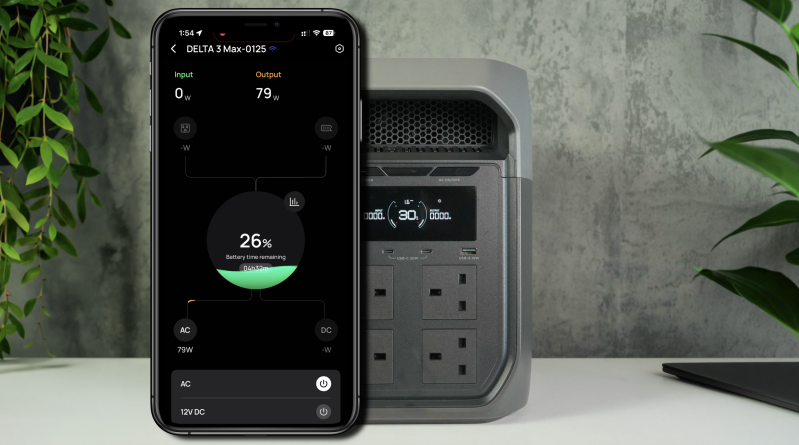
EcoFlow’s app is one of the better companion apps in the portable power station space. A lot of power station apps feel like they were designed purely to expose settings, rather than to be genuinely pleasant to use. EcoFlow’s approach is more polished.
Open the app and the important information is immediately visible: battery percentage, input, output and estimated runtime. That is exactly what you want. You do not have to dig through menus just to find out whether your desk is pulling 80W or 300W.
The scheduling features are especially useful if you are on a cheaper overnight electricity tariff. In that kind of setup, you can charge the DELTA 3 Max during lower-cost hours and then use the stored energy during more expensive daytime periods. That will not suddenly eliminate your energy bill, but for a home office, router, laptop and smaller electronics, it can help shift some usage away from peak-rate electricity.
The app also helps you understand your energy habits. Once you start looking at daily usage graphs, you notice patterns. You see when your workstation spikes, how much your router uses, how much charging an iPad or camera battery adds, and how quickly heavier equipment drains the battery. That visibility is genuinely useful.
The downside is that the app can feel a little busy at first. There are quite a few settings, and not all of them are explained in the most beginner-friendly way. EcoFlow gives you a lot of control, which is good, but the first hour with the app may involve a bit of tapping around to understand what everything does.
For most people, though, the basics are easy enough. You can treat it simply as a dashboard and only go deeper when you want scheduling, charging limits or more advanced energy management.
FEATURES & PERFORMANCE
Capacity and Daily Runtime
The DELTA 3 Max has a 2048Wh battery, which is just over 2kWh. That number is the foundation of the whole product. It is large enough to run a home office for a serious amount of time, but still compact enough to be classed as portable.
In the test scenario, the setup included:
- MacBook Air
- External monitor
- Basic internet router
- Desk light
- iPad Pro top-ups
- Camera batteries
- Drone batteries
That is a very realistic modern work-from-home or creator desk setup. It is not an extreme workstation, but it is also not just a laptop on its own.
The average draw was around 70W to 90W once everything was running, with the number leaning higher when the iPad or other accessories were charging. Using 80W as a sensible average, the DELTA 3 Max has more than enough capacity for a full working day.
On paper, 2048Wh divided by 80W gives over 25 hours. In reality, you do not get perfect conversion because the inverter and electronics use energy too. A more realistic estimate is around 20 hours of light office use, which lines up well with the experience described in the script.
That is excellent for this use case. At around 80W, you are using roughly 4% of the battery per hour. After two hours, the battery might only be down around 8%. Halfway through a workday, there should still be loads of capacity left. For laptop-based workers, writers, editors, students, small business owners or anyone running a modest desk setup, that is the sweet spot.
It means the DELTA 3 Max is not just a “get me through a short power cut” device. For lighter equipment, it can genuinely run your working day without making you feel like you are constantly watching the percentage.
Heavier Workstation Use
Things change when your desk becomes more serious. A laptop dock, two monitors, external drives, speakers, a NAS, more lighting, charging equipment and a higher-performance laptop can easily push usage into the 250W to 300W range for long periods.
At 300W, the battery drains much faster. A simple calculation gives just under seven hours from 2048Wh, but once inverter losses and real-world conditions are included, a more realistic figure is around 5.5 to 6.5 hours of solid workstation use.
That is still useful, but it is a very different experience from the 80W desk setup. With a heavier workstation, the DELTA 3 Max becomes more of a half-day to working-day support system rather than something that will run endlessly in the background. It still gives you protection, flexibility and usable backup time, but you need to be aware of how quickly heavier gear consumes energy.
This is also where solar becomes more interesting. A modest solar panel may not fully refill the DELTA 3 Max while you work, especially on a typical UK day, but it can slow the battery drain. If your setup is pulling 250W and solar is feeding in 100W to 300W depending on conditions, that can significantly extend your runtime.
The key is setting expectations. Solar is not magic. It depends on panel size, positioning, weather, season and sunlight. But as a trickle-charge support system, it pairs nicely with this kind of battery.

High-Wattage Appliances
EcoFlow markets the DELTA 3 Max series as capable of running household appliances, and in terms of output, that is fair. The standard model’s 2400W continuous AC output is enough for a lot of demanding devices, and the Max Plus pushes even further with 3000W continuous output.
But this is where buyers need the biggest reality check: powering a high-wattage appliance is not the same as powering it for a long time.
A kettle, microwave, hairdryer, heater, toaster or air fryer can pull a huge amount of power. The DELTA 3 Max can handle many of these loads, but they will chew through the battery far faster than a laptop or router.
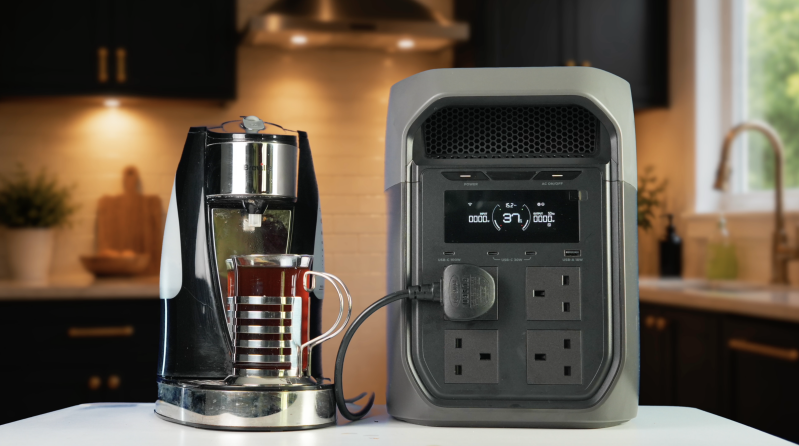
Take a typical 2kW kettle. Running it for a couple of minutes is absolutely fine. The power station can handle that kind of short burst. But do it repeatedly and you will see the battery percentage drop quickly. Heat-based appliances are some of the most energy-hungry things in the home, and a portable battery makes that very visible.
A rough estimate of 14 to 16 kettle boils from a full battery is reasonable depending on kettle power, water amount, starting temperature and boil time. That is not bad at all for an emergency, camping setup or campervan scenario. But if someone imagines they can use this like an unlimited kitchen socket all day, they will be disappointed.
The same applies to microwaves and heaters. Short bursts? Fine. Long heating sessions? That is where the battery drains quickly.
This is not a weakness of EcoFlow specifically. It is simply battery maths. A 2kWh battery is brilliant for electronics, workstations, routers, lights, fridges, coolers, charging and emergency essentials. It is less impressive if you expect it to behave like the grid for high-wattage heat appliances over long periods.
Charging Speed
Charging speed is one of EcoFlow’s biggest strengths, and the DELTA 3 Max continues that reputation.
EcoFlow lists fast AC charging at up to 2300W, with a full charge taking around 68 minutes under suitable conditions. The company also promotes very rapid 0–80% charging, which is one of the major reasons these units are so convenient in real life.
That matters because a large power station is only as useful as your ability to refill it. If a battery takes half a day to charge, you have to plan around it. With the DELTA 3 Max, you can top up quickly from mains power, which makes it much easier to use regularly rather than only keeping it for emergencies.
For example, if you realise the unit is low before an evening outage, a van trip, a filming session or a long workday, you can put a meaningful amount of energy back into it in a relatively short period. That changes how you use it. It becomes more flexible and less of a hassle.
The trade-off is that fast charging can be noisy and more demanding, depending on settings and conditions. EcoFlow typically allows some control over charging behaviour through the app, so users who prioritise quieter operation or battery longevity may prefer to reduce charge speed when they are not in a hurry.
Solar Charging
Solar charging is useful, but this is one of the areas where the standard DELTA 3 Max needs a balanced explanation.
The standard DELTA 3 Max supports up to 500W of solar input. The DELTA 3 Max Plus supports up to 1000W. That means the Plus model has a clear advantage if you want solar to be a major part of your setup.
With the standard Max, 500W solar input is enough for practical top-ups and slower off-grid charging, but it is not the fastest solar input you can find in this capacity class. In perfect conditions, 500W can still put meaningful energy into the battery, but UK weather is rarely perfect. Real-world solar output can be far below panel rating depending on cloud, angle, season and shade.
For a home office, this is still useful. If you are using 80W and solar is bringing in even 100W to 200W, you can massively extend runtime or even offset the load during good daylight. For a 300W workstation, solar may not fully keep up, but it can slow the drain.
Where it becomes less ideal is if your goal is to fully recharge the battery quickly from solar alone. In that case, the Max Plus — or a different model with stronger solar input — may be the smarter buy.
UPS-Style Backup
EcoFlow quotes a sub-10ms UPS auto-switch for the DELTA 3 Max series. That is useful for home office equipment because it means the unit can switch over very quickly when mains power drops.
It is important to be clear here: this should not be confused with a dedicated enterprise-grade UPS for servers, medical equipment or mission-critical IT infrastructure. But for normal home office use — router, laptop dock, monitor, external drives and general electronics — it can be extremely useful.
The practical difference is simple. Without backup, a power cut can reset your router, interrupt video calls, shut down external drives or knock out your network. With a fast-switching power station in the chain, your essential devices have a much better chance of staying alive through short outages.
For anyone working from home, that peace of mind is valuable. Even if you only get a handful of power interruptions a year, avoiding one lost call, corrupted file transfer or dead router during a deadline can make the feature worthwhile.
REAL-WORLD EXPERIENCE
The DELTA 3 Max makes the most sense when used as part of an everyday system rather than treated purely as an emergency gadget.
For a normal home office, it works extremely well. A MacBook Air, monitor, router, desk light, iPad and smaller charging devices are exactly the sort of loads this product handles comfortably. It is quiet enough for desk-side use most of the time, the display gives you instant feedback, and the app helps you understand what is happening without making the experience feel too technical.
The best part is how quickly it changes your relationship with power. You start noticing that your basic desk might only use 70W to 90W once settled. You realise your monitor is not as expensive to run as you thought, but charging multiple devices or adding extra equipment does make a difference. You also start to see how little power some essential items use compared with heat-based appliances.
For remote workers, that awareness is genuinely useful. It helps you build a more efficient setup, and it gives you options. You can charge the battery overnight, use it during the day, top it up with solar when possible, or keep it connected as a backup layer.
For creator setups, it also makes sense. Camera batteries, drone batteries, lights, laptops and tablets are all easy loads for this kind of unit. If you film in a garage, shed, van, cabin or location where wall sockets are awkward, the DELTA 3 Max gives you a lot of flexibility.
For campervan use, it is even more compelling. The output is strong enough for plenty of everyday van-life devices, and the capacity is large enough to be practical without installing a full custom electrical system. It could power laptops, lighting, a fridge or cooler, camera gear, chargers and occasional appliances, depending on the setup.
However, the weight matters in all of these scenarios. At around 20kg, this is something you move deliberately. It is portable in the sense that you can take it places, not portable in the sense that you casually carry it everywhere. For a van, desk, garage or home backup corner, that is fine. For lightweight travel, it is too heavy.
The other thing to remember is price. At around £1,199 for the standard unit at the time of review, this is a serious purchase. It only really makes sense if you have a genuine use case: backup power, work-from-home reliability, cheaper tariff shifting, solar top-ups, van use, creative work, or regular off-grid power needs.
If you just want to charge your phone during a power cut, this is overkill. If you want to keep your office, router, laptop and essential kit running for hours, it starts to feel much more justified.
PROS
- Large 2048Wh capacity is excellent for home office use
- Easily runs a typical desk setup for a full workday
- Strong AC output: 2400W on DELTA 3 Max, 3000W on Max Plus
- Four UK mains sockets make it practical for real devices
- Fast AC charging is a major convenience
- Useful front display with battery, input, output and runtime information
- EcoFlow app is clear, useful and better than many competitors’ apps
- Scheduling is handy for cheaper overnight electricity tariffs
- LFP battery chemistry is reassuring for long-term use
- Can work well as a UPS-style backup for home office equipment
- Good option for campervans, garages, creators and off-grid setups
- Solar compatibility adds useful flexibility
- Max Plus model offers stronger solar input and higher output
- Helps users understand real-world energy consumption more clearly
CONS
- Around 20kg, so it is portable but not easy to carry often
- Expensive compared with smaller power stations
- Standard DELTA 3 Max solar input is limited to 500W, which may feel low for solar-heavy users
- Box contents are quite minimal for the price
- No included storage bag or wider cable bundle with the basic package
- Display is clear but not especially easy to read from a distance
- App has a lot of settings and may take time to learn properly
- High-wattage appliances drain the battery quickly
- Not a replacement for a full home solar or whole-house battery system
- Buyers need to choose carefully between the Max and Max Plus because the differences are meaningful
- For very light users, it may be more power station than they actually need
WHO IS THIS FOR?
The EcoFlow DELTA 3 Max is best suited to people who have a real need for reliable portable power rather than those simply looking for a large gadget.
It is a very good fit for home workers who want to keep a desk setup running during outages, or who want to shift some usage to cheaper charging periods. If your setup includes a laptop, monitor, router, lighting and a few devices charging throughout the day, this power station has more than enough capacity to make sense.
It is also ideal for creators who regularly charge camera batteries, drones, lights, laptops and tablets. The ability to run a compact creative setup away from the wall is genuinely useful.
Campervan owners should also pay attention. The DELTA 3 Max offers a simpler alternative to a fully built-in electrical system, especially for people who want power without rewiring a van. It will not suit every permanent van-life setup, but for occasional trips, weekend use, mobile work or flexible backup, it is very strong.
It also suits households that want practical emergency backup for essentials such as a router, laptop, small fridge, lights or medical-adjacent comfort devices — though anything medically critical should always use properly approved backup systems.
The people who should think twice are those who want something genuinely lightweight, those expecting it to power high-wattage appliances for long periods, or those hoping it will replace a proper whole-home solar installation. It is powerful, but it is still a 2kWh portable power station, not an unlimited energy source.

FINAL VERDICT
The EcoFlow DELTA 3 Max is one of those products that makes more sense the more realistically you use it.
As a home-office battery, it is excellent. It can comfortably run a modest desk setup for a full day, and even with heavier workstation equipment, it still provides meaningful runtime. The display is useful, the app is genuinely helpful, the AC output is strong, and the fast charging makes it far easier to live with than slower power stations.
It is also a strong choice for campervans, creative work, garage power, emergency backup and anyone who wants a flexible 2kWh battery without going down the route of a permanent home installation.
But it is not perfect. The weight means it is not something you casually carry around, the standard model’s solar input is not class-leading, and the price means it needs to solve a real problem in your life. It is also worth being honest about high-wattage appliances. Yes, it can run them, but no, it will not run them forever. Heat uses a lot of energy, and a battery this size makes that very obvious.
For the “can it run my work-from-home setup?” question, the answer is yes — comfortably. For a typical laptop, monitor, router and accessory setup, it has more than enough capacity to get through the day with room to spare. Add solar or cheaper overnight charging into the mix, and it becomes even more interesting.
The EcoFlow DELTA 3 Max is not a magic money-saving box, and it is not a full home energy system. But as a serious, desk-side, van-ready, outage-friendly power station, it is a very solid piece of kit that feels powerful, practical and genuinely useful.
Watch the full cinematic video review on Gadget Crunch’s YouTube channel.
Add comment
Comments