


Introduction
Outdoor security cameras have come a long way in recent years. What started as relatively simple devices designed to capture movement outside your home has evolved into something considerably more sophisticated, with higher-resolution sensors, intelligent detection, automatic tracking and increasingly flexible installation options.
However, one problem remains surprisingly common.
Traditional pan-and-tilt security cameras can follow movement across your property, but the moment they turn towards something interesting, they stop watching whatever was originally in front of them. That might not sound particularly important until you consider what happens when someone approaches your driveway while the camera is busy tracking movement elsewhere.
It’s a limitation that TP-Link is attempting to solve with the Tapo C675D KIT, a solar-powered outdoor security camera that takes a rather different approach to monitoring your property.
Instead of relying on one rotating camera, the C675D combines two completely independent 4K cameras within a single housing. The upper camera provides an extremely wide, fixed view of your surroundings, while a second motorised telephoto camera underneath can rotate, zoom and automatically follow movement.
The idea is straightforward: one camera keeps an eye on the bigger picture, while the other concentrates on the details.
Add a rechargeable 10,000mAh battery, an included 4.5W solar panel, intelligent person and vehicle detection, colour night vision and subscription-free local storage, and the C675D starts to look like a particularly interesting option for anyone wanting comprehensive outdoor security without installing several separate cameras.
But impressive specifications don’t always translate into a better everyday experience.
After spending approximately a month with the Tapo C675D installed overlooking a driveway, there are several things that stand out, particularly its image quality and dual-camera arrangement. There are also a few compromises worth understanding before deciding whether this is the right security camera for your home.
Quick Summary
The TP-Link Tapo C675D KIT is an impressive outdoor security camera, particularly for homeowners wanting to monitor larger spaces such as driveways, gardens and multiple entry points.
Its biggest advantage is undoubtedly the dual-camera system. Having a fixed 4K wide-angle camera working alongside a separate 4K motorised telephoto camera provides a level of flexibility that conventional single-lens cameras struggle to match.
Daytime footage is detailed, night vision performs well, and automatic tracking generally does a good job of following people and slower-moving vehicles.
The included solar panel also makes installation considerably more convenient, while local microSD storage means you aren’t forced into paying for a monthly subscription.
However, the maximum 15fps recording frame rate is disappointing, tracking isn’t flawless, and the relatively bulky design won’t suit every installation.
It’s also important to understand that Tapo’s advertised 24/7 Continuous Capture feature doesn’t provide uninterrupted video recording.
Overall, this is a capable and thoughtfully designed security camera that makes the most sense when its additional coverage is genuinely useful.


What’s in the Box?
The Tapo C675D KIT includes the main camera alongside the accessories required for a typical outdoor installation.
Inside the packaging, you’ll find:
- TP-Link Tapo C675D dual-lens security camera
- Tapo A202 4.5W solar panel
- Solar panel mounting bracket
- USB charging cable
- Solar panel extension cable
- Mounting screws and wall anchors
- Mounting templates
- Quick-start guide
The supplied extension cable measures approximately 3.6 metres, giving you useful flexibility when positioning the solar panel.
This is particularly important because the best location for monitoring your property isn’t necessarily the best location for collecting sunlight.
One thing that isn’t included is a microSD card. If you want to record footage locally without subscribing to Tapo’s cloud service, you’ll need to purchase one separately.
Otherwise, the package is reasonably comprehensive, with no permanent electrical connection required for normal solar-powered operation.
Design & Build Quality
A substantial camera with a practical purpose
The first thing you’ll notice about the Tapo C675D is its size.
This certainly isn’t one of those compact outdoor cameras designed to disappear discreetly beneath a roofline.
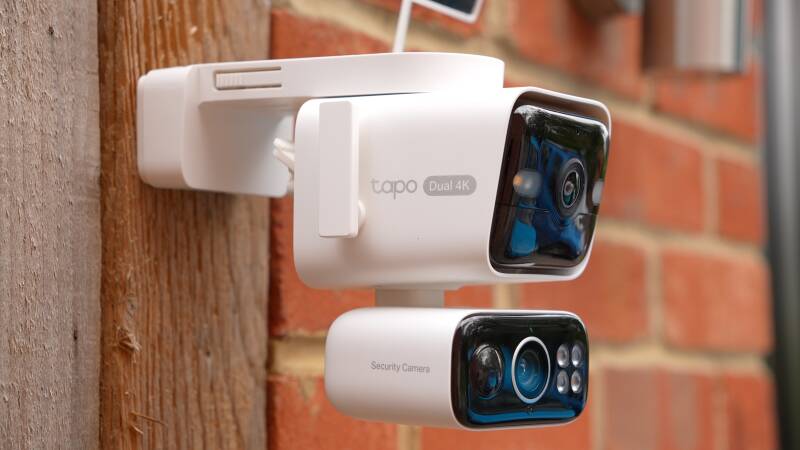
Measuring approximately 102.2 × 160.3 × 132mm, the C675D has a substantial housing that accommodates two separate camera systems, a motorised tracking mechanism, lighting hardware and its internal battery.
The design is distinctive, with the larger fixed camera positioned at the top and the rotating telephoto camera suspended underneath.
Both cameras have their own lighting systems, while additional red-and-blue warning lights provide a more visible deterrent when the alarm functionality is activated.
Despite its size, the overall design feels modern and purposeful.
Considering that you’re effectively getting two separate 4K cameras in one device, the dimensions aren’t particularly unreasonable.
In fact, for homeowners who want their security equipment to be visible, the larger housing could even be considered an advantage.
A clearly visible security camera may discourage some opportunistic activity, although its presence alone shouldn’t be relied upon as a complete security solution.
Built for outdoor conditions
The C675D carries an IP65 weather-resistance rating, meaning its enclosure is designed to protect against dust and water jets.
For typical UK installations, that makes it suitable for exposure to rain, wind-driven moisture and everyday outdoor conditions.
TP-Link also specifies an operating temperature range of approximately -20°C to 45°C.
However, there’s an important distinction between the camera’s operating temperature and its battery-charging temperature.
The battery’s specified charging range begins at 0°C, meaning extremely cold conditions can restrict charging even when the camera itself remains operational.
That’s worth remembering if you’re planning to install it somewhere exposed during winter.
The separate solar panel: flexible but less discreet
One design decision that divides opinion is the separate solar panel.
Unlike cameras with solar panels integrated directly into their housing, the C675D uses an external 4.5W panel connected by cable.
There are advantages and disadvantages to this approach.
On the positive side, you can position the camera exactly where it provides the best view while mounting the solar panel somewhere with better access to sunlight.
For example, the camera could sit underneath a roof overhang, protected from direct exposure, while the solar panel is installed higher up where it receives more daylight.
That’s a particularly sensible arrangement for UK properties, where sunlight can be limited by neighbouring buildings, trees and rooflines.
The downside is that you’re installing two separate components rather than one.
You’ll need to consider cable routing, mounting positions and the overall appearance of the installation.
It’s not quite as tidy as an integrated solar-powered camera, but the additional flexibility is arguably more valuable than having everything contained within one housing.
Setup & First Impressions
Straightforward installation without permanent wiring
One of the biggest advantages of the C675D is that it doesn’t require a permanent electrical supply.
Because the camera runs from its internal rechargeable battery, there’s no need to install an outdoor socket or run power cables through your walls.
That immediately makes it more practical for locations such as detached garages, garden walls and driveways where convenient power connections might not be available.
Installation is relatively straightforward.
After selecting a suitable position, the camera can be secured using the supplied mounting hardware.
The solar panel is then installed separately and connected using the included extension cable.
With approximately 3.6 metres of additional cable available, there’s enough flexibility for many typical home installations.
Naturally, mounting into brickwork or positioning the camera at height may require more preparation than installing it onto a wooden surface.
However, the basic process is simple and doesn’t require specialist electrical knowledge.

Connecting to the Tapo app
Once the camera is mounted, the remaining setup takes place through the Tapo mobile application.
The app guides you through connecting the camera to your Wi-Fi network, configuring its settings and enabling the monitoring features you want to use.
The C675D supports both 2.4GHz and 5GHz Wi-Fi, which is useful because many battery-powered outdoor cameras are limited to 2.4GHz connections.
However, the best option will depend on your installation.
A 2.4GHz connection will often provide better coverage through walls and over longer distances, while 5GHz can be useful when the camera is relatively close to a compatible router.
During our setup, the process was straightforward and took only a few minutes once the camera was ready to connect.
The app is reasonably intuitive, and the most important controls are easy to locate.
There are plenty of additional settings available, but you don’t need to configure everything immediately to start monitoring your property.
For most people, getting the camera connected and working shouldn’t be particularly challenging.
Features & Performance
Dual 4K Cameras: The Biggest Reason to Buy It
The defining feature of the Tapo C675D is its dual-camera arrangement.
And importantly, these aren’t simply two lenses working together to produce one combined image.
They’re two independent 4K cameras designed to perform different jobs.
The fixed 4K wide-angle camera
The upper camera uses an 8-megapixel sensor capable of recording at 3840 × 2160 resolution.
Its most impressive specification is the 169.7-degree diagonal field of view, which provides an exceptionally broad perspective.
In practical terms, this allows the camera to monitor a substantial area without needing to be positioned particularly far away.
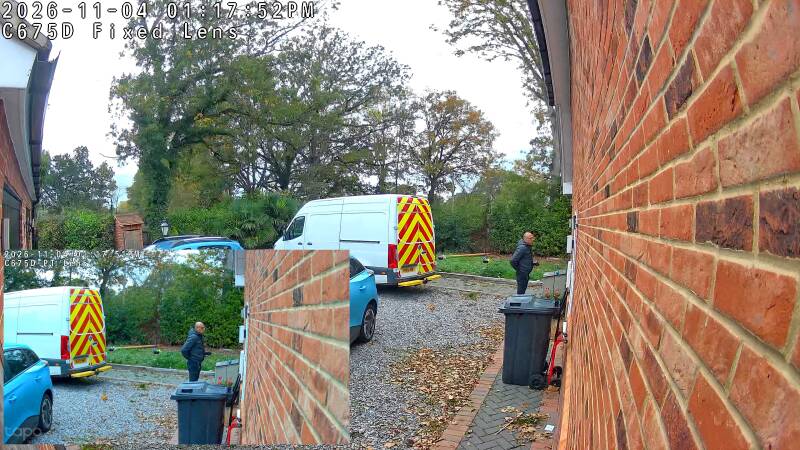
For example, when overlooking a driveway, the fixed camera can capture the main parking area alongside much of the surrounding space.
That’s useful because a conventional camera with a narrower field of view might require a more carefully chosen mounting position or an additional camera to cover the same area.
The wide-angle lens is particularly valuable for maintaining awareness of everything happening across your property.
However, there is a natural compromise.
When a camera captures such a wide scene, individual objects occupy a relatively small portion of the image.
Even with 4K resolution, identifying fine details at greater distances can become more difficult.
And that’s where the second camera becomes particularly interesting.
The motorised 4K telephoto camera
Positioned underneath the fixed camera is another 8-megapixel 4K sensor.
However, this one uses a narrower 6mm telephoto lens with a 66.5-degree diagonal field of view.
Rather than capturing as much of the surrounding environment as possible, its job is to provide a closer perspective of whatever it’s monitoring.
The camera can also physically rotate, with TP-Link advertising 360-degree horizontal monitoring coverage.
This allows it to follow movement across a much larger area than a fixed telephoto camera could monitor on its own.
The real advantage becomes apparent when both cameras are working together.
Imagine somebody walking onto your driveway.
The upper camera continues monitoring the entire area, while the lower camera rotates towards the person and follows their movement.
You’re effectively getting two perspectives of the same event: one showing the wider surroundings and another concentrating on the subject.
That’s a much more useful arrangement than having a single camera constantly turning away from its original monitoring position.
For larger properties, it could potentially reduce the need for additional cameras, depending on the layout and the areas you need to monitor.
How useful is the 18× zoom?
TP-Link advertises up to 18× zoom, which sounds particularly impressive.
However, it’s important to understand what that actually means.
The C675D doesn’t contain an 18× optical zoom lens.
Instead, its telephoto camera provides a naturally narrower perspective, while additional magnification is achieved digitally.
The dedicated telephoto lens is the important part here.
Because it captures a closer view optically, distant subjects can contain more usable detail than they would if you simply cropped into the wide-angle camera’s image.
Additional digital zoom can help you examine a particular area, but image quality will inevitably deteriorate as magnification increases.
In our experience, the closer telephoto perspective is genuinely useful, and the camera retains a pleasing amount of detail when zooming in.
However, buyers shouldn’t expect the maximum zoom setting to deliver the same clarity as a dedicated long-range optical zoom camera.
For everyday home security, the more meaningful benefit is being able to switch between a broad overview and a closer perspective without installing another device.
Automatic Tracking: Clever and Generally Effective
Automatic tracking is another major part of the C675D’s appeal.
Using its intelligent detection system, the camera can identify movement and direct the motorised telephoto lens towards the subject.
This works alongside the fixed wide-angle camera, which continues monitoring the surrounding area.
During our testing, the tracking system generally performed well when following people walking at a normal pace.
It also handled slower-moving vehicles approaching the driveway reasonably effectively.
For these everyday situations, the camera usually managed to keep the subject within view without requiring manual intervention.
It’s an impressive feature when everything works as intended.
However, tracking isn’t completely flawless.
Faster movements and sudden changes in direction can be more challenging, particularly when the motorised camera needs to rotate quickly to locate a subject.
Independent testing has also highlighted occasional delays when the camera needs to respond to movement from a different position.
This can become more noticeable when using Patrol Mode, where the motorised camera moves between predefined monitoring positions.
If something happens while the telephoto camera is facing elsewhere, there may be a delay before it rotates towards the activity.
By that point, a fast-moving subject could already have left the area.
Fortunately, the fixed camera provides a useful safety net.
Even when the tracking camera doesn’t capture the ideal close-up, the wide-angle lens can still provide footage of what happened within its field of view.
That doesn’t completely eliminate missed events, but it makes the dual-camera arrangement considerably more reassuring than relying entirely on one rotating lens.
For typical driveway and garden monitoring, the tracking system is a useful addition rather than something we’d consider essential for every situation.
Daytime Image Quality: One of Its Strongest Features
Image quality is arguably one of the most convincing reasons to consider the Tapo C675D.
Both cameras record in 4K, and the difference is noticeable when reviewing footage from the two perspectives.
During our testing, daytime recordings looked detailed, with pleasing colours and a good amount of clarity across the image.
The fixed camera does an excellent job of capturing the wider environment, while the telephoto camera provides a noticeably closer view of subjects further away.
It’s particularly impressive that both cameras offer the same 4K recording resolution.
Some dual-lens security cameras prioritise one sensor, leaving the secondary camera with noticeably lower image quality.
That isn’t the case here.
Although the two lenses naturally produce different perspectives, both are capable of delivering detailed footage.
The telephoto camera is especially useful when trying to examine activity towards the far end of a driveway or garden.
Rather than relying entirely on digital cropping, its narrower lens provides a more detailed starting point.
That said, image quality can still depend on lighting conditions, distance and camera settings.
Independent testing has identified occasional exposure issues in bright scenes, although adjusting the camera’s exposure settings can improve the results.
For our installation, the overall daytime image quality has been one of the strongest aspects of the experience.
The disappointing 15fps limitation
There is, however, one specification that feels slightly out of place on such an advanced camera.
Despite offering dual 4K recording, the C675D is limited to a maximum of 15 frames per second.
For comparison, footage recorded at 25 or 30fps generally looks noticeably smoother, particularly when subjects are moving quickly.
At 15fps, everyday security recordings remain perfectly usable.
However, movement doesn’t look quite as fluid as we’d ideally like.
This becomes more noticeable when someone moves quickly across the frame or when the motorised camera rotates to follow activity.
There’s also the potential for additional motion blur, depending on lighting and exposure.
It doesn’t undermine the camera’s excellent image detail, but it does prevent the overall video experience from feeling quite as polished as the resolution might suggest.
For a premium security camera, a higher recording frame rate would have been welcome.

Night Vision: Impressive Flexibility After Dark
A security camera needs to perform when visibility is limited, and the C675D offers several useful options for nighttime monitoring.
Both cameras support traditional infrared night vision alongside colour recording using their built-in lighting systems.
Having the choice is important because different installations benefit from different approaches.
Infrared night vision
Infrared recording produces the familiar black-and-white footage associated with traditional security cameras.
It might not look as visually appealing as full-colour video, but it’s often the more practical option for everyday monitoring.
For example, if your camera overlooks a driveway close to neighbouring properties, you might not want bright white spotlights activating every time somebody walks past.
Infrared allows the camera to monitor the area without constantly illuminating it with visible white light.
During our testing, the infrared footage provided a clear view of the monitored area, with enough detail to understand what was happening.
Naturally, the image doesn’t retain the same colour information as daytime footage, but visibility remains useful.
Full-colour night vision
When additional detail is needed, the C675D can use its built-in white LEDs to illuminate the scene.
This allows the cameras to capture colour footage rather than relying entirely on infrared.
The difference can be particularly useful when reviewing an incident.
Being able to distinguish the colour of someone’s clothing or a vehicle can provide information that black-and-white footage might not reveal.
The C675D also uses Starlight image sensors and relatively wide f/1.6 apertures to help capture more light.
However, colour night vision still depends on available illumination, and the spotlights become especially important in darker environments.
During our testing, both infrared and illuminated colour footage produced pleasing results.
The images weren’t quite as clean as daytime recordings, which is to be expected, but the overall clarity was impressive.
For us, the biggest advantage isn’t necessarily that one mode looks better than the other.
It’s having the flexibility to choose the most appropriate option for your installation.

AI Detection and Smart Security Features
Modern security cameras need to do more than simply record movement.
They also need to recognise which events are worth notifying you about.
Otherwise, even an excellent camera can become frustrating when your phone constantly alerts you to moving trees, passing traffic or other irrelevant activity.
The Tapo C675D includes intelligent detection for:
- People
- Vehicles
- Pets
- General movement
These core detection features are available without requiring a Tapo Care subscription.
That makes it possible to configure notifications around the activity that actually matters to you.
For example, somebody monitoring a driveway might want alerts when a person approaches the house or a vehicle enters the property.
Meanwhile, someone monitoring a garden might be more interested in detecting people and pets.
Detection zones make a difference
One feature we’d strongly recommend using is the ability to configure activity zones.
These allow you to define which parts of the camera’s view should trigger alerts.
This becomes particularly important when the camera overlooks a road, pavement or neighbouring driveway.
Without carefully configured detection zones, the wide field of view can result in notifications for activity outside the area you’re actually interested in.
Independent reviewers have also reported occasional false vehicle alerts, where the camera incorrectly interprets activity involving parked or passing cars.
Although we wouldn’t describe that as a universal problem, it’s something buyers should be aware of.
Spending a little time adjusting detection zones and sensitivity settings can make the system considerably more manageable.
Two-way audio
The C675D also includes a microphone and speaker for two-way communication through the Tapo app.
This allows you to speak to someone near the camera without physically going outside.
It’s useful for situations such as communicating with a delivery driver or speaking to someone approaching your property.
However, audio quality is naturally affected by distance and environmental conditions.
Wind noise can be particularly challenging for outdoor microphones, and independent testing has identified this as a limitation.
The feature is useful for occasional communication, but it shouldn’t be confused with a dedicated outdoor intercom system.
Siren and warning lights
Additional security features include a built-in siren and flashing red-and-blue warning lights.
These can be configured to activate when certain events are detected.
The idea is to draw attention to suspicious activity and potentially discourage unwanted visitors.
It’s a useful addition, although we wouldn’t rely on it as the primary method of protecting a property.
A determined intruder may not be particularly concerned by flashing lights or an audible warning.
Nevertheless, as part of a broader home security setup, the additional deterrent features are worth having.

Battery Life and Solar Charging
A 10,000mAh battery designed for extended operation
Power management is one of the most important considerations when choosing a wireless outdoor security camera.
The C675D contains a rechargeable 10,000mAh battery, which TP-Link claims can provide up to 90 days of operation on a single charge.
However, that figure is based on specific usage conditions rather than continuous video recording.
In practice, battery endurance will depend on several factors, including how frequently the camera detects movement, how often the motorised lens tracks subjects and how regularly you access live footage.
Night vision, spotlight usage and Wi-Fi signal strength can also affect power consumption.
A camera monitoring a quiet garden will generally have very different power requirements from one overlooking a busy driveway.
How effective is the included solar panel?
The supplied 4.5W solar panel is designed to replenish the camera’s battery throughout the day.
According to TP-Link, approximately 90 minutes of direct sunlight can provide enough energy for typical daily operation under its specified test conditions.
That’s an appealing claim, particularly for anyone hoping to avoid regularly removing or manually charging an outdoor camera.
However, sunlight isn’t always predictable.
Here in the UK, shorter winter days, prolonged cloud cover and shaded mounting positions can significantly reduce the amount of energy available.
It’s therefore worth treating the manufacturer’s estimate as an indication of what’s possible under favourable conditions rather than a guarantee of year-round maintenance-free operation.
Our experience after one month
During our testing, the camera remained installed for approximately a month.
Over that period, the battery level didn’t fall below 50%, which is an encouraging result.
Considering the camera is operating two 4K imaging systems alongside intelligent detection and motorised tracking, that’s a reassuring early indication of its power efficiency.
However, one month isn’t enough to establish how the system will perform throughout an entire year.
The real challenge for solar-powered security cameras in the UK is often winter, when daylight hours are shorter and several overcast days can arrive consecutively.
It’s possible that occasional manual charging may still be necessary, depending on the installation and usage.
Nevertheless, our initial experience has been positive.
For homeowners who don’t have convenient access to outdoor electricity, the combination of battery power and solar charging is a major advantage.
24/7 Continuous Capture: Useful, but Not Continuous Video
One feature that deserves a little explanation is Tapo’s 24/7 Continuous Capture.
At first glance, the name might suggest that the camera records uninterrupted video throughout the day and night.
However, that’s not how the system works.
Instead, the C675D can capture individual images at regular intervals between normal motion-triggered video recordings.
Depending on your settings, these snapshots can be taken at intervals ranging from approximately one second to 60 seconds.
When the camera detects relevant movement, it switches to recording video.
The result is a more complete visual record of activity than you’d normally get from a battery camera that only records when motion is detected.
For example, you might be able to look back through snapshots to see when a vehicle appeared on your driveway, even if you don’t have a conventional video recording covering that exact moment.
It’s a clever compromise designed to provide additional monitoring information without the enormous battery demands of continuous 4K video recording.
However, there is an important limitation.
This isn’t a replacement for genuine 24-hour video surveillance.
If something happens between snapshots and doesn’t trigger a motion recording, the camera could still miss it.
For homeowners who specifically require uninterrupted video footage, a permanently powered security camera or wired CCTV system would be a more appropriate choice.
For a battery-powered product, though, Continuous Capture is a useful feature that adds another layer of visibility between recorded events.

The Tapo App and Everyday Usability
A security camera can have excellent hardware, but if its companion application is difficult to navigate, the overall experience quickly becomes frustrating.
Fortunately, the Tapo app is one of the more straightforward aspects of using the C675D.
During our testing, switching between the two camera views was simple, and the main controls were reasonably easy to find.
The app provides access to live footage, recorded events, tracking settings, activity zones and notification preferences.
You can also control the motorised camera manually when you want to examine a particular area.
This is especially useful with the telephoto lens, as you can move the camera towards something interesting without waiting for automatic tracking to activate.
Finding recordings
One of the more important parts of any security camera application is how easily you can locate a specific event.
After all, there isn’t much point recording detailed footage if finding the relevant clip becomes a frustrating process.
The Tapo app provides a recording timeline alongside tools for reviewing detected activity.
Some additional filtering and organisation features are available through Tapo Care, including more advanced ways to sort recorded events.
That’s slightly disappointing, particularly when the camera already includes intelligent detection capabilities.
However, the core application remains functional without a subscription.
For everyday monitoring, the overall experience is straightforward, and having both camera feeds accessible through one interface is particularly convenient.
Local Storage and Tapo Care: Do You Need a Subscription?
One of the biggest advantages of the Tapo C675D is that a monthly subscription isn’t essential.
The camera includes a microSD card slot supporting capacities of up to 512GB.
Once a compatible card is installed, recordings can be stored locally and accessed through the Tapo application.
This means you can use the camera’s core features without committing to ongoing cloud-storage payments.
For anyone who dislikes the idea of paying every month simply to access recordings from hardware they’ve already purchased, that’s a significant advantage.
What works without a subscription?
The C675D supports several important features without Tapo Care, including local video recording, live viewing, standard notifications, core AI detection and two-way audio.
This makes it a relatively flexible option for buyers who want to minimise ongoing ownership costs.
However, a microSD card does need to be purchased separately.
It’s also worth remembering that footage stored exclusively inside the camera could be lost if the device is stolen or damaged.
That isn’t a problem unique to Tapo, but it’s an important consideration for anyone relying entirely on local storage.
Smart Home Compatibility and Connectivity
The C675D also supports several popular smart-home ecosystems, including Amazon Alexa, Google Assistant, Samsung SmartThings and IFTTT.
This provides additional flexibility for households already using connected devices.
However, the exact functionality available will depend on the platform and integration.
Not every feature accessible through the Tapo app will necessarily be available through a third-party smart-home system.
There is also one important limitation for more advanced users.
The C675D doesn’t support standard RTSP or ONVIF connections.
These protocols are commonly used by traditional IP security cameras and network video recording systems.
Their absence means the C675D may not integrate easily with an existing CCTV installation or third-party recording software.
There’s no Ethernet connection either, so the camera relies on Wi-Fi for network connectivity.
For someone planning to use the Tapo app and local microSD storage, this probably won’t be a major concern.
However, buyers building a more advanced home surveillance system should consider these restrictions before purchasing.

Real-World Experience: Does Having Two Cameras Actually Help?
After approximately a month of using the Tapo C675D, the feature that continues to stand out is the relationship between the two cameras.
On paper, dual 4K sensors sound impressive.
But in everyday use, the real advantage isn’t simply having twice the camera hardware.
It’s the ability to monitor the same environment in two completely different ways.
With the C675D positioned overlooking a driveway, the fixed camera provides a broad view of the surrounding area.
Meanwhile, the motorised telephoto camera can concentrate on activity such as somebody approaching a vehicle or walking towards the property.
This arrangement makes considerably more sense than relying entirely on one camera to provide both broad coverage and close-up detail.
The fixed camera doesn’t need to abandon its original view whenever the tracking system becomes active.
And even when automatic tracking isn’t quite fast enough, there’s still the wider perspective available.
That’s an important practical advantage.
Where it works particularly well
The C675D is especially well suited to locations where there’s a meaningful distance between the camera and the area you want to monitor.
A large driveway is an obvious example.
The fixed lens can capture the overall space, while the telephoto camera provides a closer view of people or vehicles moving through it.
The same principle applies to larger gardens, gates and properties with multiple points of interest.
For these situations, the dual-camera arrangement could potentially replace the need for two separate cameras, although that will depend on the layout of the property.
The image quality is another highlight.
Both cameras produce detailed footage, and the telephoto lens adds genuine value rather than feeling like a secondary feature included simply to make the specifications more impressive.
Automatic tracking has also been useful during normal everyday activity.
It’s not perfect, but for people walking and vehicles moving at slower speeds, it generally performs well.
Where the compromises become noticeable
The limitations are mostly connected to movement, installation and the type of recording available.
The 15fps frame rate means footage isn’t as smooth as we’d ideally like.
The motorised camera can occasionally struggle to respond quickly enough to sudden movement.
And while the solar panel provides welcome installation flexibility, it does require additional mounting and cable management.
The lack of genuine continuous video recording is another important consideration.
For many homeowners, motion-triggered recordings and interval-based snapshots will be sufficient.
However, anyone wanting a complete, uninterrupted video record should consider a different type of camera.
These aren’t necessarily deal-breaking problems, but they help define who the C675D is best suited to.
Pros
- Two independent 4K cameras: Excellent flexibility for capturing wide scenes and closer details simultaneously.
- Extremely wide 169.7° field of view: Particularly useful for monitoring larger driveways and gardens.
- Dedicated telephoto camera: Provides a closer perspective without relying entirely on digital cropping.
- Useful automatic tracking: Generally follows people and slower-moving vehicles effectively.
- Excellent daytime image quality: Detailed footage with pleasing colours and strong overall clarity.
- Good night-vision performance: Both infrared and illuminated colour recording provide useful visibility.
- Included 4.5W solar panel: Reduces the need for manual charging and permanent power connections.
- Encouraging battery performance: Our camera remained above 50% during approximately one month of testing.
- Subscription-free local storage: Supports microSD cards up to 512GB.
- Intelligent detection: Person, vehicle and pet detection help make notifications more relevant.
- Straightforward Tapo app: Easy access to both camera views and important settings.
- Flexible installation: Separate solar panel can be positioned for better sunlight exposure.
Cons
- Limited to 15fps recording: Motion isn’t as smooth as we’d expect from a premium 4K security camera.
- Tracking isn’t flawless: Faster movement and sudden changes in direction can cause problems.
- Premium purchase price: Difficult to justify if you only need basic monitoring.
- Relatively bulky design: More noticeable than smaller outdoor security cameras.
- Separate solar panel: Requires additional mounting and cable routing.
- No genuine continuous video recording: 24/7 Continuous Capture uses interval-based snapshots between motion events.
- No RTSP or ONVIF support: Restricts integration with traditional CCTV systems.
- Some app features require Tapo Care: Advanced cloud functionality and certain event-management tools involve ongoing costs.
- Winter solar performance remains uncertain: Extended periods of limited sunlight may require occasional manual charging.
- MicroSD card sold separately: An additional purchase is required for local recording.

Final Verdict: Is the TP-Link Tapo C675D KIT Worth Buying?
Overall, I think the TP-Link Tapo C675D KIT is a genuinely impressive outdoor security camera, and after spending around a month with it installed, I’ve been particularly pleased with how well the dual-camera system works in everyday use. For me, that’s easily its biggest selling point. Rather than simply adding a second lens to make the specifications look more impressive, TP-Link has created a setup where both cameras serve a clear purpose. The fixed 4K camera provides an exceptionally wide view of your property, while the motorised telephoto camera can follow movement and capture a much closer perspective of what’s happening. It’s a sensible approach that addresses one of my biggest frustrations with traditional pan-and-tilt cameras, where tracking something often means losing sight of the area you originally wanted to monitor.
Image quality is another area where the C675D has impressed me. Both cameras produce detailed 4K footage, with good colours, plenty of clarity and a noticeable advantage when switching between the wide-angle and telephoto perspectives. I also think the night vision performs particularly well, whether you’re using traditional infrared recording or the built-in spotlights for full-colour footage. Automatic tracking has generally been reliable during my testing, especially when following people walking at a normal pace or vehicles moving slowly onto the driveway. It’s not completely flawless, and faster movements can occasionally catch it out, but having that second fixed camera makes those limitations considerably easier to live with. Even when the tracking camera doesn’t respond quite quickly enough, you’ve still got the wider view providing useful coverage.
The solar-powered design is another feature I’ve appreciated, particularly because it removes the need to run permanent power cables to the installation location. During my month of testing, the battery hasn’t dropped below 50%, which I think is a reassuring result considering the amount of technology packed into this camera. Of course, I’d still want to see how it performs through a full British winter before making any firm claims about long-term solar reliability, especially during extended periods of cloudy weather. I also appreciate the option to record footage locally using a microSD card without being forced into a monthly subscription. It’s something I always like to see on security cameras, particularly when you’re already spending a considerable amount on the hardware itself.
That said, there are a few compromises worth considering. The biggest disappointment for me is the 15fps recording limitation, which feels slightly restrictive for a camera offering two 4K sensors. The footage is still perfectly usable for everyday security, but movement isn’t quite as smooth as I’d ideally like, particularly when the motorised camera is tracking something quickly. The separate solar panel also means there’s a little more work involved during installation, and the lack of RTSP or ONVIF support could be frustrating if you’re planning to integrate it into an existing CCTV system. It’s also important to understand that Tapo’s 24/7 Continuous Capture feature isn’t genuine continuous video recording, but rather a combination of interval-based snapshots and motion-triggered footage. None of these issues would necessarily stop me from recommending it, but they’re worth understanding before spending your money.
Ultimately, whether the Tapo C675D KIT is worth buying comes down to the size of the area you’re trying to monitor and how much you’ll benefit from having two separate camera perspectives. If you’re simply looking to keep an eye on a small doorway or compact garden, I think there are considerably cheaper cameras that will do the job perfectly well. However, if you’ve got a larger driveway, garden or multiple areas you want to monitor, the combination of an ultra-wide 4K camera and a dedicated telephoto tracking camera starts to make much more sense. You’re getting excellent image quality, useful automatic tracking, flexible solar-powered installation and the convenience of local storage, all within one system. For the right property, I can certainly see how that additional coverage could justify spending more than you would on a conventional outdoor camera.
For me, the biggest reason to recommend the Tapo C675D isn’t simply the dual 4K resolution, the solar charging or the intelligent detection features. It’s the fact that I can keep an eye on the entire driveway while the second camera independently follows movement and captures a closer view of what’s happening. That’s something a traditional single-lens pan-and-tilt camera simply can’t achieve in the same way, and it’s what makes the C675D such an interesting option. It’s certainly not perfect, and I’d have liked smoother recording and slightly faster tracking in certain situations, but after a month of using it, I’ve come away genuinely impressed. If you’re looking for a capable, high-resolution outdoor security camera that offers more flexibility than a conventional single-camera setup, I think the Tapo C675D KIT is well worth considering.
Watch the full cinematic video review on Gadget Crunch’s YouTube channel.
Add comment
Comments