

Introduction
Folding electric bikes are supposed to make life easier. They’re designed to offer the convenience of electric assistance while remaining compact enough to store at home, take on public transport or fit into the back of a car.
Unfortunately, there’s often one rather significant problem: weight.
Once you start adding an electric motor, battery, reinforced frame and all the necessary components, many folding e-bikes can end up weighing well over 20kg. Suddenly, that convenient little bicycle becomes considerably less appealing when you’re carrying it upstairs or navigating a busy railway station.
That’s precisely the problem the ADO Air Carbon Pro is attempting to solve.
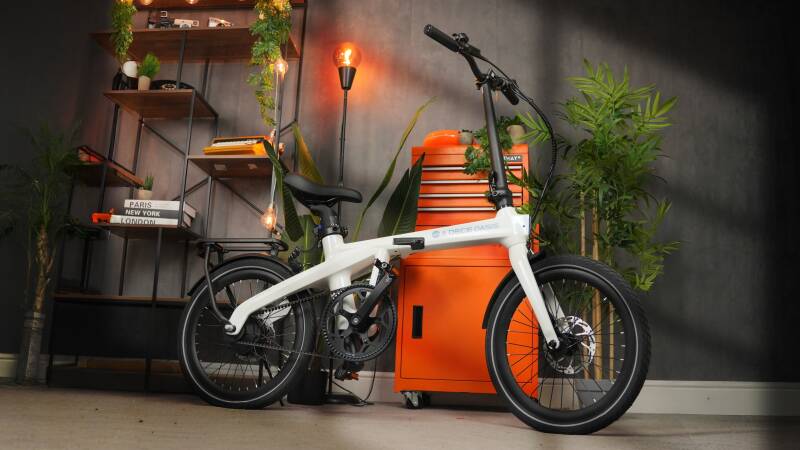
Built around a lightweight carbon-fibre frame and fork, this premium folding electric bike weighs a claimed 16.2kg. That’s an impressive figure considering the amount of technology ADO has managed to squeeze into it.
But the Air Carbon Pro isn’t simply about saving weight.
There’s a 250W Bafang rear-hub motor with automatic two-speed gearing, a dual-sided torque sensor, a low-maintenance carbon belt drive, Tektro hydraulic disc brakes and integrated GPS tracking.
You even get NFC unlocking, a colour display and a removable battery cleverly concealed inside the seatpost.
Perhaps most interestingly, the bike takes care of changing gears automatically. There’s no conventional gear shifter to worry about, and no need to remember to change down when approaching traffic lights or climbing a hill.
It’s an interesting approach to electric cycling, particularly for commuters who value simplicity.
However, at £1,999 in the UK, the Air Carbon Pro sits firmly in premium territory.
And while its specification looks impressive, there are some important compromises worth considering, including its relatively large folded dimensions, complete lack of suspension and a few practical design choices that won’t suit everyone.
So, does the ADO Air Carbon Pro genuinely make folding electric bikes more convenient, or is it simply an expensive bicycle packed with clever technology?
Let’s take a closer look.
Quick Summary
The ADO Air Carbon Pro is a premium folding electric bike designed primarily for urban commuting, leisure riding and convenient transportation.
Its biggest strengths are its lightweight carbon-fibre construction, smooth automatic two-speed motor and clean, low-maintenance belt drivetrain.
Together, these features create an electric bike that prioritises straightforward everyday riding rather than complicated controls or outright performance.
The 250W Bafang motor provides useful assistance when accelerating and climbing hills, while the automatic transmission makes it easier to maintain a comfortable pedalling rhythm as your speed changes.
The integrated battery, hydraulic brakes, lighting and smart security features also help justify its premium positioning.
However, this isn’t necessarily the ideal folding bike for everyone.
Although relatively lightweight for an electric bicycle, 16.2kg is still substantial when carrying it upstairs. The 20-inch wheels also mean it doesn’t fold into an especially small package, and manoeuvring it while folded can be awkward.
There’s no suspension, no standard kickstand and some aspects of the accompanying smartphone app could benefit from further refinement.
Overall, the Air Carbon Pro makes the most sense for riders who want a sophisticated, relatively lightweight electric bike that happens to fold, rather than someone whose absolute priority is achieving the smallest possible folded package.


What’s in the Box?
One of the first things worth appreciating about the ADO Air Carbon Pro is that it doesn’t require the same level of assembly as some electric bicycles.
The bike arrives largely assembled, meaning you won’t need to build an entire bicycle from individual components.
The supplied bicycle includes the following equipment:
- ADO Air Carbon Pro folding electric bike
- Carbon-fibre frame and fork
- Integrated 370Wh removable seatpost battery
- Bafang automatic two-speed rear-hub motor
- Carbon belt drivetrain
- Tektro hydraulic disc brakes
- Integrated front and rear lighting
- MIK-compatible rear luggage rack
- Mudguards
- NFC unlocking functionality and supplied NFC key card
A charging adapter and assembly tools are referenced in independent unboxing coverage, although the complete UK retail accessory inventory has not been independently confirmed.
Optional accessories, such as additional luggage bags, baskets and storage solutions, should not be assumed to be included with the standard bicycle.
Assembly and Initial Setup
The initial setup is relatively straightforward.
The main tasks involve unfolding the frame, securing the handlebar assembly, positioning the saddle and checking that the necessary clamps and fasteners are correctly tightened.
Compared with electric bicycles that arrive with wheels, handlebars and other major components requiring installation, this is a considerably more approachable process.
However, there’s one important point worth emphasising.
Because the Air Carbon Pro uses folding joints and quick-release mechanisms, it’s particularly important to check that everything is properly secured before riding.
That includes the central frame hinge, handlebar clamp, steering assembly and seatpost locking mechanism.
If you’re unfamiliar with bicycle assembly, having a qualified mechanic perform a safety check would be a sensible precaution.
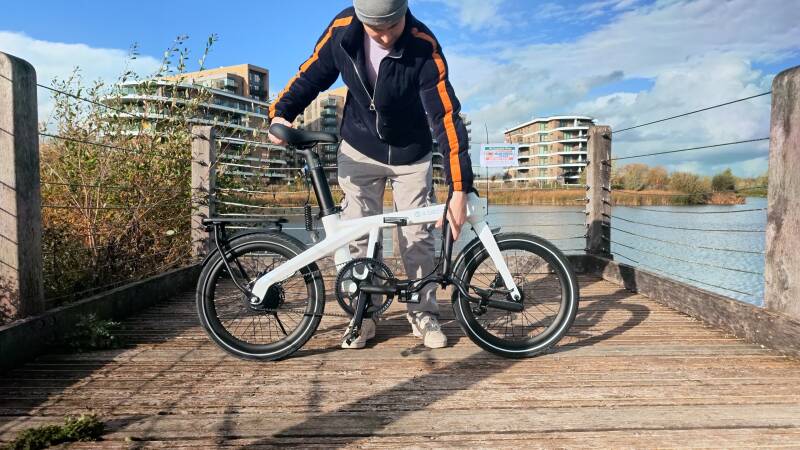
Once assembled, the Air Carbon Pro makes a strong visual impression.
And that’s largely because it looks quite different from the average folding electric bike.
Design & Build Quality
A Carbon-Fibre Frame That Makes a Difference
The first thing that stands out about the ADO Air Carbon Pro is its frame.
Rather than using the aluminium construction found on many folding electric bicycles, ADO has opted for carbon fibre throughout both the main frame and fork.
The result is a particularly clean, modern-looking bicycle with smooth frame surfaces, integrated components and very little unnecessary visual clutter.
There’s something quite appealing about the way the frame has been designed.
The sculpted carbon construction gives it a more premium appearance than many conventional folding bikes, while the carefully routed cabling helps maintain that minimalist aesthetic.
Even the battery has been integrated into the seatpost rather than mounted externally to the frame.
It’s a design that feels deliberately considered rather than simply built around finding somewhere to attach an electric motor.
Carbon fibre also brings some practical benefits.
It’s lightweight, doesn’t rust like conventional steel and can be engineered to manage certain types of vibration.
However, it’s worth remembering that carbon fibre isn’t indestructible.
Significant impacts can damage composite structures, and repairs are generally more specialised than those required for conventional metal bicycle frames.
That doesn’t indicate a problem with the Air Carbon Pro specifically, but it is something worth considering when investing in a carbon-fibre folding bicycle.
Is 16.2kg Actually Lightweight?
ADO claims the complete Air Carbon Pro weighs approximately 16.2kg, including its standard equipment.
For a folding electric bicycle with a 370Wh battery, hydraulic brakes, integrated lighting and a rear luggage rack, that’s a respectable achievement.
Many electric bikes weigh considerably more.
However, I think it’s important to keep that figure in perspective.
Sixteen kilograms is still a substantial amount of weight if you’re carrying a bicycle through a railway station, lifting it into a car or taking it upstairs.
It’s certainly more manageable than a 25kg electric bike, but that doesn’t automatically make it effortless to carry.
ADO also specifies a measurement tolerance of approximately 3–5%, so the quoted figure shouldn’t be interpreted as the exact weight of every individual bicycle.
Ultimately, the reduced weight is a genuine advantage, but how useful it becomes depends heavily on how frequently you actually need to lift the bike.
Wheels, Tyres and Everyday Equipment
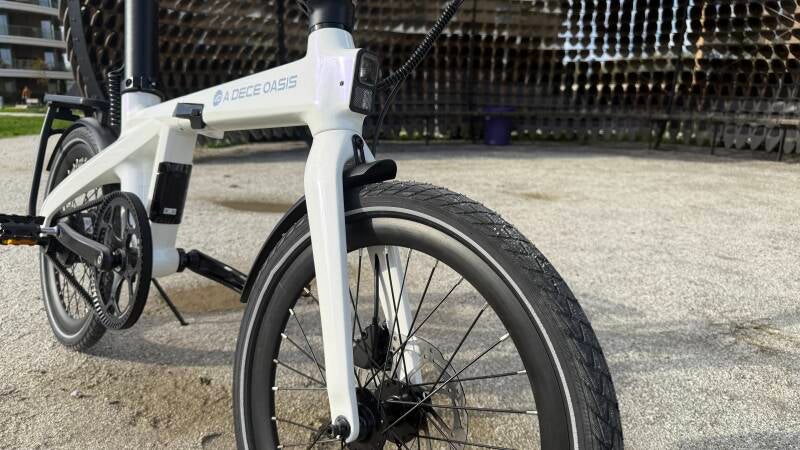
The Air Carbon Pro uses 20-inch wheels fitted with relatively narrow 1.75-inch tyres.
This is an interesting middle ground.
Larger wheels generally offer a more familiar riding experience than the smaller wheels found on some ultra-compact folding bicycles.
They can also make it easier to maintain momentum on typical urban roads.
However, larger wheels inevitably increase the amount of space the bike occupies when folded.
It’s a compromise that becomes particularly noticeable when comparing the Air Carbon Pro with smaller folding alternatives.
Elsewhere, ADO has included integrated front and rear lighting, mudguards and a rear luggage rack.
The rack supports the MIK accessory system and has a published maximum load capacity of 15kg.
That’s a useful addition for commuting.
A compatible pannier bag could comfortably accommodate everyday essentials such as a laptop, waterproof jacket, lunch and smaller personal belongings, provided the total load remains within the rack’s limit.
The front of the bicycle also supports ADO’s AQS accessory system for compatible luggage solutions.
These details help make the Air Carbon Pro feel like a practical transport option rather than simply a recreational gadget.
Hydraulic Disc Brakes
Braking duties are handled by Tektro hydraulic disc brakes.
At this price, that’s a welcome inclusion.
Hydraulic systems generally provide more consistent braking control and require less routine cable adjustment than basic mechanical disc brakes.
They’re particularly useful on an electric bicycle, where the additional weight and assisted acceleration place greater demands on the braking system.
However, the presence of hydraulic brakes doesn’t automatically guarantee exceptional stopping distances.
Actual braking performance still depends on factors such as tyre grip, road conditions, brake maintenance and rider technique.
Nevertheless, they’re an appropriate component choice for a premium commuter.
A Carbon Belt Drive — Cleaner, Quieter and More Convenient
One of my favourite design decisions on the Air Carbon Pro is the absence of a conventional bicycle chain.
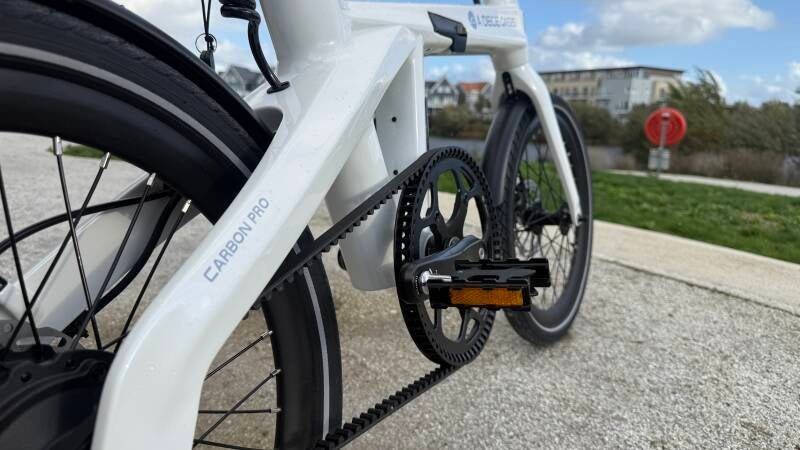
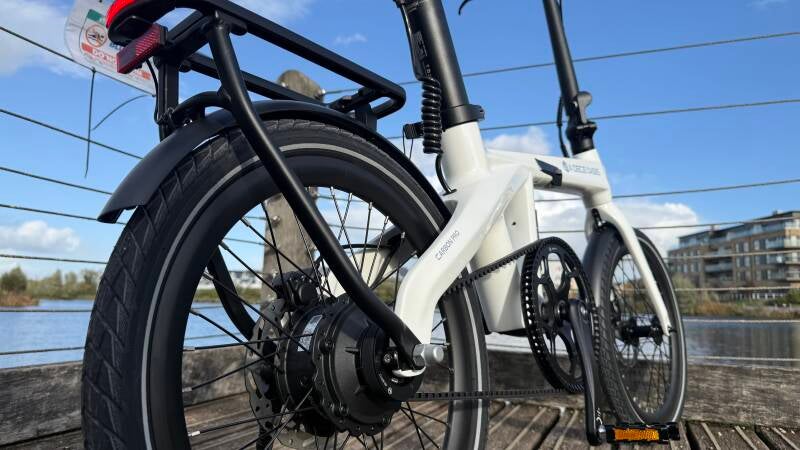
Instead, ADO has fitted a carbon belt drivetrain.
And for an everyday electric commuter, I think this makes a great deal of sense.
Traditional bicycle chains work perfectly well, but they require regular cleaning and lubrication, particularly if you’re commuting throughout the year.
They can also collect dirt, become noisy and leave oily marks on clothing.
A belt drive largely avoids those inconveniences.
There’s no conventional chain oil to worry about, which is particularly appealing if you’re cycling to work in everyday clothing.
Belt systems also tend to operate quietly when correctly adjusted.
Combined with the Air Carbon Pro’s automatic hub transmission, this creates a drivetrain designed around smooth, uncomplicated cycling.
Of course, belt drives aren’t completely maintenance-free.
You still need to monitor belt condition, tension and alignment, and replacement components must be compatible with the system.
It’s also worth checking the availability and price of replacement belts before purchasing.
But for riders who would rather spend their time cycling than regularly cleaning and lubricating a chain, it’s a very sensible arrangement.
Motor & Performance — The Automatic Two-Speed System Is the Star
If there’s one feature that makes the ADO Air Carbon Pro particularly interesting, it’s the motor.
At the rear sits a Bafang H700 hub motor producing 250W of rated power and a claimed maximum torque output of 50Nm.
Those figures are fairly typical for a road-focused electric bicycle intended for the UK market.
What’s less typical is the integrated automatic two-speed transmission.
How Does the Automatic Gearing Work?
Most conventional bicycles require you to change gears manually.
And even some electric bikes with relatively sophisticated motors still rely on traditional gear shifters and derailleurs.
The Air Carbon Pro takes a different approach.
Its two-speed transmission is built into the rear hub and changes ratios automatically according to riding conditions.
When you’re pulling away from a standstill or travelling at lower speeds, the bike uses its lower gear.
This helps provide a more suitable ratio for acceleration and climbing.
As your speed increases to approximately 19km/h, the transmission automatically changes into its higher ratio.
That allows you to continue pedalling at a more comfortable cadence as you approach cruising speed.
When you slow down again, the system returns to the lower ratio.
The real advantage here is convenience.
Imagine riding through a busy town centre with regular traffic lights, pedestrian crossings and junctions.
On a conventional bicycle, you’re constantly changing gears as you slow down, stop and accelerate again.
With the Air Carbon Pro, that process happens automatically.
You simply pedal, and the transmission takes care of selecting the appropriate ratio.
It’s a particularly appealing arrangement for people who want electric cycling to feel straightforward rather than mechanical.
Does Automatic Gearing Actually Improve the Ride?
The concept sounds clever, but automatic transmissions are only genuinely useful when the changes happen smoothly.
An unpredictable gear change or sudden interruption in assistance could quickly become frustrating.
Fortunately, independent road tests of the Air Carbon Pro have been encouraging.
Reviewers have praised the way the Bafang system transitions between ratios without noticeably interrupting forward momentum.
Rather than feeling like a conventional bicycle abruptly changing gears, the transmission is designed to operate quietly in the background.
That makes it particularly well suited to stop-start urban riding.
However, there is a trade-off.
You don’t have the same level of control offered by a conventional multi-speed transmission.
If you’re an experienced cyclist who enjoys choosing specific ratios for different gradients and riding conditions, the automatic system might feel restrictive.
And with only two available ratios, it won’t offer the same flexibility as a bicycle equipped with a wider-range conventional gearbox.
But for the intended audience, I think simplicity is very much the point.

Dual-Sided Torque Sensing
The automatic gearing is complemented by a dual-sided torque sensor.
This is another important part of the riding experience.
Cheaper electric bikes often rely on cadence sensors, which primarily detect whether the pedals are rotating.
Torque sensors go further by measuring the effort you’re applying through the pedals.
The harder you pedal, the more assistance the motor can provide within the selected assistance setting.
That generally creates a more progressive and natural feeling of power delivery.
Rather than having the motor suddenly engage simply because the pedals are moving, the assistance is designed to respond more closely to your own input.
It’s particularly useful when accelerating away from junctions, adjusting your speed around pedestrians or climbing hills.
The combination of torque sensing and automatic gearing is arguably the Air Carbon Pro’s strongest technical feature.
Both systems work towards the same goal: making the bike easier to ride without constantly thinking about what the motor and transmission are doing.
Hill-Climbing Performance — Better Than You Might Expect
Hill climbing is one of the areas where the Air Carbon Pro’s automatic transmission becomes particularly useful.
Single-speed electric bicycles can sometimes feel compromised when tackling steeper gradients.
A gear ratio that works well for cruising on flat roads isn’t necessarily ideal when you’re climbing slowly.
The Air Carbon Pro’s lower gear helps address that limitation.
With 50Nm of claimed torque and a transmission designed to provide a more suitable ratio at lower speeds, the motor has a useful mechanical advantage when climbing.
Independent reviewers have reported encouraging results on gradients approaching 8–10%.
The assistance remains useful as the incline increases, although the rider still needs to contribute more effort on steeper sections.
That’s an important distinction.
This is still a 250W pedal-assisted electric bicycle.
It isn’t designed to carry you effortlessly up every hill without meaningful input.
Your weight, battery level, chosen assistance mode and the length of the climb will all affect the experience.
A short, steep hill is also very different from a sustained climb lasting several kilometres.
Nevertheless, the available riding evidence suggests the Air Carbon Pro is well suited to the sort of moderate hills commonly encountered during urban commuting.
And I think that’s where the automatic gearing really earns its place.
You don’t need to anticipate the gradient by changing gears manually.
You can concentrate on maintaining a comfortable pedalling rhythm while the transmission manages the ratio.
For everyday riding, that’s a genuinely useful advantage.
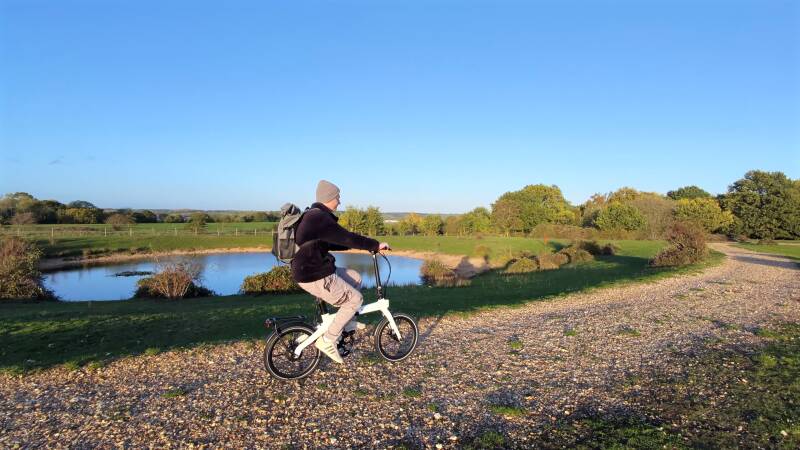
Battery & Range — How Far Can the ADO Air Carbon Pro Travel?
The Air Carbon Pro uses a 370Wh lithium-ion battery integrated into its seatpost.
It’s a clever design choice.
Rather than attaching a large battery pack to the frame, ADO has concealed it within the seatpost assembly.
This helps maintain the bicycle’s clean appearance while keeping the battery relatively central.
The battery is also removable, allowing it to be taken indoors for charging.
That’s particularly useful if you live in a flat or store your bicycle somewhere without convenient access to a power socket.
The seatpost locking mechanism provides an additional layer of security by helping prevent casual removal of the battery.
Battery Specifications
The published electrical specifications include:
- Battery capacity: 370Wh
- Nominal voltage: 37V
- Capacity: 10Ah
- Charging time: approximately 4–6 hours
- Removable seatpost battery design
What About the Claimed Range?
This is one area where buyers should pay attention to the published figures.
ADO’s international product information advertises a maximum assisted range of up to 100km, equivalent to approximately 62 miles.
However, the UK product listing currently specifies a maximum range of 80km, or approximately 50 miles.
Both are manufacturer estimates rather than independently verified real-world results.
The difference is worth noting, particularly if range is a major consideration.
As with virtually every electric bicycle, actual battery endurance depends on several factors.
These include rider weight, terrain, temperature, wind resistance, tyre pressure, assistance level and how much effort you’re contributing through the pedals.
A relatively lightweight rider using minimal assistance on flat roads will generally achieve considerably better efficiency than someone using maximum assistance over repeated steep climbs.
What Should You Realistically Expect?
Without a controlled battery-depletion test, it wouldn’t be accurate to promise a particular real-world distance.
However, the 370Wh capacity gives us a useful indication of what might be possible.
For example, if the bike averaged 6Wh of electrical energy consumption per kilometre, the theoretical range would be approximately 62km.
At a more demanding 10Wh per kilometre, that would fall to around 37km.
These are illustrative calculations, not measured Air Carbon Pro results.
They demonstrate why maximum manufacturer range claims should always be treated as best-case estimates.
Independent reviewers have reported encouraging efficiency during shorter urban journeys, particularly when using lower assistance settings.
But the available evidence doesn’t establish that the bike will consistently achieve its maximum advertised range.
Is 370Wh Enough?
For the type of riding this bicycle is designed around, I think 370Wh is a sensible capacity.
It’s large enough to offer useful assistance for many everyday commuting journeys without requiring the substantial additional weight of a much larger battery.
If you’re travelling a few miles to work, cycling to a railway station or using the bike for shorter leisure rides, the battery capacity should be relatively well suited to that purpose.
Longer journeys involving steep hills and high assistance settings will naturally place greater demands on it.
One thing I’d like to see more clearly established is the long-term cost of replacement batteries.
Because the battery uses a specialised integrated seatpost design, replacement availability and pricing are worth confirming before purchase.
Riding Experience & Comfort
The Air Carbon Pro is very much an urban-focused electric bicycle.
Its relatively upright riding position, raised handlebars and 20-inch wheels create a setup designed more around everyday comfort and visibility than aggressive performance riding.
And for commuting, that makes sense.
An upright position can make it easier to observe traffic and surrounding road conditions without adopting the forward-leaning posture associated with road bikes.
It’s also a relatively approachable arrangement for leisure cyclists.
However, the handlebar position is something worth considering.
If you’re accustomed to a mountain bike or conventional road bicycle, the comparatively high bars may initially feel unusual.
Some riders will appreciate the relaxed posture immediately.
Others may prefer a lower or more adjustable setup.
The Air Carbon Pro doesn’t offer the same degree of handlebar-height adjustment as some alternative folding bicycles, so checking the fit before purchasing would be worthwhile.
No Suspension — And That’s Worth Remembering
One of the biggest compromises is the complete absence of suspension.
There’s no front suspension fork and no rear suspension system.
Instead, the bike relies on its carbon-fibre construction, tyres and saddle to manage vibrations and smaller road imperfections.
On smooth roads and well-maintained cycle paths, this arrangement makes sense.
It keeps weight down, reduces mechanical complexity and helps maintain efficient pedalling.
However, rough roads tell a different story.
Potholes, broken tarmac and substantial surface irregularities will still transmit impacts through the bike.
Carbon fibre can help manage some higher-frequency vibrations, but it isn’t a replacement for proper suspension.
The relatively narrow tyres also provide less cushioning than the larger-volume tyres found on some comfort-focused electric bicycles.
Consequently, I wouldn’t recommend the Air Carbon Pro primarily for off-road riding.
It’s much better suited to tarmac, urban cycle routes and relatively smooth recreational paths.
If your regular journeys involve badly maintained roads or uneven surfaces, comfort is something I’d investigate carefully before committing.
Handling and Stability
The 20-inch wheels are a sensible choice for this style of bike.
They offer a useful compromise between manageable folding dimensions and a more conventional riding feel.
Compared with smaller-wheeled folding bicycles, they can feel more familiar when maintaining speed or travelling over minor road imperfections.
The narrow tyres are also designed to roll efficiently.
Independent testing has highlighted their ability to maintain momentum during city riding, while offering sufficient grip for their intended urban environment.
However, tyre grip will always depend on surface conditions, pressure and wear.
The Air Carbon Pro is best understood as a lightweight road-focused commuter rather than an all-terrain electric bike.
Folding Mechanism & Portability — Convenient, but Not Especially Compact
Of course, the main reason many people will consider the Air Carbon Pro is its folding design.
And thankfully, the process itself is relatively straightforward.
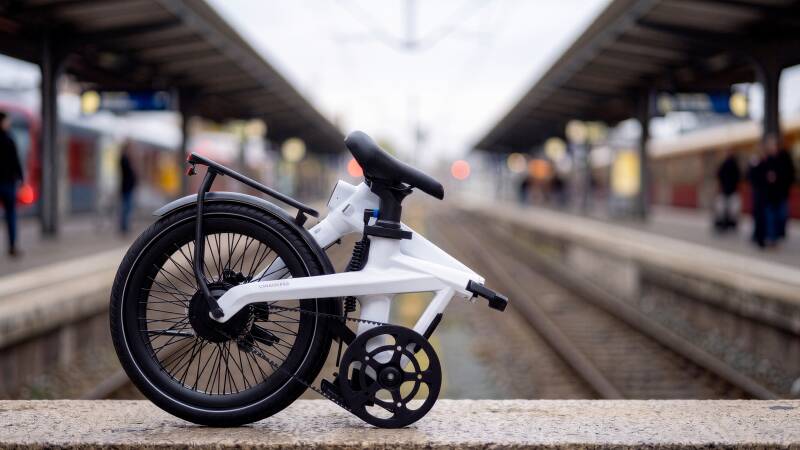
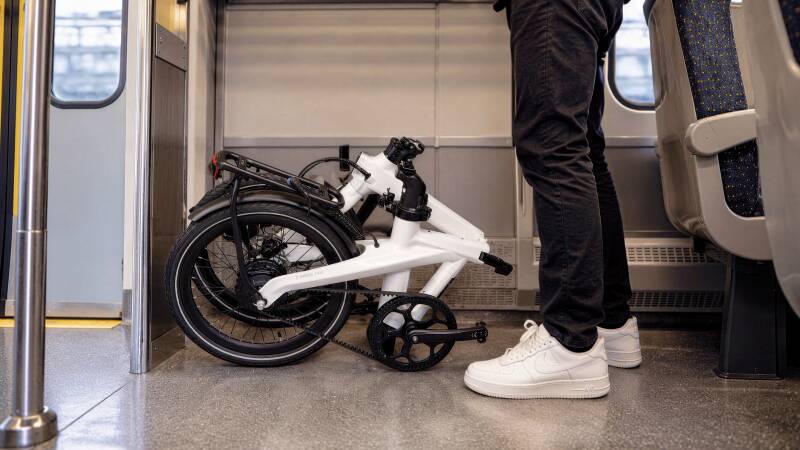
The bicycle uses a central frame hinge, a folding handlebar assembly and a seatpost that can be lowered to reduce the overall height.
Once the appropriate locking mechanisms are released, the frame folds inwards to create a smaller package.
There’s also a magnetic retention system designed to help keep the two halves together when folded.
That’s a particularly useful detail.
One of the frustrations with some folding bicycles is having the frame sections move apart while you’re trying to carry or reposition them.
The magnetic system helps make the folded bicycle easier to manage.
How Practical Is the Fold?
ADO advertises a particularly quick folding process.
In practice, folding time will depend on familiarity with the mechanism and whether additional accessories need repositioning.
The more important question is what happens once the bike has been folded.
And this is where the Air Carbon Pro becomes slightly less convincing.
Although the frame folds into a substantially smaller package, the 20-inch wheels still occupy a reasonable amount of space.
It doesn’t become particularly tiny.
If you’re comparing it with something like a Brompton, which has been engineered specifically around achieving an exceptionally compact folded shape, there’s a noticeable difference.
The Air Carbon Pro is more accurately described as a bicycle that folds for convenient storage and transportation rather than an ultra-compact folding system.
Carrying and Rolling the Bike
Another limitation is how the bicycle behaves when folded.
Independent reviewers have reported that manoeuvring it on its wheels isn’t always straightforward.
The position of the pedals and front mudguard can cause interference when attempting to roll the folded bike.
That can mean having to lift it rather than simply pushing it along.
And suddenly, the 16.2kg weight becomes relevant again.
While that’s relatively light for an electric bike, carrying it through a busy station or up several flights of stairs still requires a reasonable amount of effort.
It’s also worth remembering that weight distribution and the availability of comfortable carrying points can matter just as much as the number on the specification sheet.
Where the Folding Design Makes Most Sense
Personally, I think the Air Carbon Pro’s folding mechanism is most appealing for occasional transportation and storage.
For example, if you want to put the bicycle in the back of a car for a weekend away, the folding frame makes that considerably more practical than transporting a conventional full-sized electric bike.
The same applies to campervan and motorhome owners.
Being able to fold the bike and store it in a relatively compact area could be a genuine advantage.
It’s also useful for people with limited storage space at home.
However, if you’re regularly folding and unfolding your bicycle several times a day, carrying it through railway stations or manoeuvring it through crowded spaces, I’d recommend paying particular attention to the folded dimensions and handling.
The Air Carbon Pro folds reasonably conveniently.
But folding convenience and genuine portability aren’t necessarily the same thing.
Display, NFC Unlocking & Smart Features
Another area where the Air Carbon Pro distinguishes itself from more conventional bicycles is its integrated technology.
Mounted on the handlebars is an IPS colour display showing essential riding information.
This includes speed, battery status and assistance settings.
The bike offers Eco and Sport riding modes, allowing you to adjust the level of electrical assistance according to the journey.
But perhaps the most interesting feature is the NFC unlocking system.
NFC Unlocking
Rather than relying exclusively on a conventional power button, ADO has incorporated NFC-based activation.
Using the supplied NFC card, you can unlock the bicycle’s electronic assistance system by holding the card near the display.
ADO claims the process takes approximately 1.7 seconds.
It’s a neat addition that makes the bike feel more like a modern connected device.
And from a security perspective, it provides another barrier against someone casually activating the motor assistance.
However, electronic unlocking also introduces another dependency.
You need access to a working NFC credential, whether that’s the supplied card or a compatible phone configuration.
If you lose the card or experience problems configuring your smartphone, that could become inconvenient.
For that reason, I’d want to make sure a reliable backup unlocking method is available before depending on the bike for daily transport.
The ADO Smartphone App
The Air Carbon Pro also works with ADO’s companion smartphone app.
The app provides access to additional riding information, settings and connected functionality.
Depending on configuration, it can also support features such as ride statistics, navigation integration and security-related functions.
It’s a useful addition in principle.
However, independent reviewers have reported occasional inconsistencies during setup and operation.
These have included registration inconveniences, confusing settings and features that haven’t always behaved as expected.
That doesn’t mean the app is unusable.
But it does suggest that the software experience isn’t necessarily as polished as the bicycle’s physical design.
For a product costing almost £2,000, I’d like to see ADO continue refining the software.
Built-In GPS Tracking
The integrated GPS tracking system is another particularly interesting feature.
Electric bicycles are valuable targets for theft, so having a way to locate your bike could potentially be useful if it goes missing.
However, GPS tracking shouldn’t be confused with theft prevention.
It doesn’t physically stop someone from taking the bicycle, and location information doesn’t guarantee recovery.
A good-quality physical lock remains essential.
There’s also an ongoing ownership cost to consider.
ADO’s UK product information currently states that full access to its smart functionality costs £10 per year after a one-year free trial.
That’s not a particularly large annual fee compared with the bike’s purchase price, but it’s still something buyers should know about.
I’d also want to confirm the precise tracking features included, mobile connectivity arrangements and whether location tracking continues when the main battery is removed.
These details matter if GPS security is one of your main reasons for choosing this model.

Integrated Lighting and Weather Resistance
The Air Carbon Pro includes integrated front and rear lights.
The front light is rated at 170 lumens, while the rear light is incorporated into the bicycle’s design.
Having lighting built into the bike is particularly convenient for commuting.
There’s less need to remember separate rechargeable lights, although riders should still check that the installed lighting meets their visibility needs and applicable road requirements.
ADO also publishes an IPX6 water-resistance rating for the bicycle, with the display rated IPX7.
That’s reassuring for a product intended for everyday outdoor use.
However, water resistance shouldn’t be interpreted as complete waterproofing.
Pressure washing, prolonged water exposure and improper storage can still create problems with electrical components.
Real-World Experience — Where the Air Carbon Pro Makes Sense
What I find most appealing about the Air Carbon Pro is that its technology has a clear practical purpose.
It’s easy for electric bicycles to become overloaded with features that sound impressive on paper but don’t necessarily improve everyday riding.
Here, most of the major components contribute towards making the bicycle simpler to live with.
The automatic transmission removes the need to think about changing gears.
The torque sensor makes electrical assistance more responsive to pedalling effort.
The belt drive reduces the cleaning and lubrication associated with a conventional chain.
And the integrated battery, lighting and security features help keep the overall package relatively tidy.
Together, these features make the Air Carbon Pro particularly appealing for everyday urban journeys.
Commuting
For someone cycling to work, the automatic transmission could be a genuine advantage.
Urban commuting often involves repeated stops, changes in speed and occasional hills.
Having the bicycle manage its gearing automatically removes one of the smaller tasks associated with conventional cycling.
The upright riding position is also well suited to navigating traffic, while the rear luggage rack adds practical carrying capacity.
The belt drive is another welcome addition if you’re regularly cycling in work clothing.
And with the motor assistance limited to 25km/h, the bike’s specification is consistent with the principal power and assisted-speed limits applicable to electrically assisted pedal cycles in Great Britain, subject to the remaining legal requirements.
Leisure Riding
The Air Carbon Pro also makes sense for relaxed recreational cycling.
Its motor assistance can help reduce the effort required to tackle moderate hills, while the automatic gearing makes it easier to concentrate on the journey.
For riders who aren’t particularly interested in managing a conventional multi-speed drivetrain, that simplicity could be especially appealing.
However, comfort will depend on the route.
Smooth roads and maintained cycle paths are where the bike is best suited.
Longer journeys over rough surfaces are likely to expose the limitations of its rigid frame and narrow tyres.
Car and Campervan Travel
This is another area where the Air Carbon Pro has considerable appeal.
A full-sized electric bicycle can be awkward to transport without a dedicated carrier.
The folding frame makes the Air Carbon Pro more practical to store in a car boot or campervan compartment, provided the available space accommodates its folded dimensions.
Its relatively low weight also helps when lifting it into a vehicle.
For someone who wants an electric bicycle available during holidays or weekend trips, that combination makes sense.
The Smaller Frustrations
Despite its thoughtful design, there are several details I’d like to see improved.
The absence of a standard kickstand is an unusual omission on a premium commuter.
It means finding somewhere suitable to lean the bicycle when stopping, unless you purchase a compatible stand separately.
The pedals are another consideration.
Independent testing has highlighted their relatively sharp edges, which can become awkward when manoeuvring the folded bike in confined spaces.
There’s also the question of long-term servicing.
The carbon frame, integrated battery, automatic hub transmission and connected electronics are all relatively specialised components.
That’s not inherently a problem, but replacement-part availability becomes increasingly important as the bike gets older.
Before purchasing, I’d want to know how easily replacement batteries, electronic components and folding mechanisms can be obtained.
And perhaps most importantly, there have been some concerns raised about the steering assembly.
One independent road test reported gradual handlebar slippage and a small amount of movement in the steering column.
These observations relate to an individual test bicycle and don’t establish that every Air Carbon Pro has the same problem.
Nevertheless, they’re worth taking seriously.
Any unexpected movement in the handlebars, steering assembly or folding joints should be investigated by a qualified mechanic before continuing to ride.
On a folding bicycle, the security and condition of these components are particularly important.
Pros — What We Like
- Lightweight carbon-fibre construction: The claimed 16.2kg weight is impressive considering the amount of integrated equipment.
- Automatic two-speed transmission: Removes the need for manual gear changes and makes stop-start commuting more convenient.
- Responsive torque sensing: Designed to deliver assistance according to pedalling effort for a more natural riding experience.
- Useful hill-climbing assistance: Independent road tests suggest the motor performs well on moderate urban gradients.
- Quiet carbon belt drivetrain: Cleaner and generally lower maintenance than a conventional lubricated chain.
- Premium integrated design: The frame, battery, lighting and cabling create a particularly tidy appearance.
- Hydraulic disc brakes: A sensible inclusion for a premium electric commuter.
- Removable 370Wh battery: Offers practical charging flexibility without a bulky external battery pack.
- Built-in GPS and NFC security: Useful connected features, particularly on an expensive electric bicycle.
- Practical luggage options: The MIK-compatible rear rack adds everyday versatility.
- Convenient folding mechanism: Useful for storage, car transportation and occasional mixed-mode journeys.
Cons — What Could Be Better?
- Expensive initial purchase: At £1,999, this is a significant investment for a folding commuter.
- Not particularly compact when folded: The 20-inch wheels result in a larger package than some smaller-wheeled alternatives.
- Awkward folded manoeuvrability: Pedal and wheel positioning can make rolling the bicycle difficult.
- Still relatively heavy to carry: Although lightweight for an electric bike, 16.2kg is substantial when lifting it upstairs.
- No suspension: Rough roads, potholes and uneven surfaces can affect comfort.
- No standard kickstand: An inconvenient omission for an everyday commuter.
- Sharp-edged pedals: Could be uncomfortable or awkward when handling the folded bike.
- Limited handlebar adjustment: The relatively high riding position won’t suit every cyclist.
- Smartphone app needs refinement: Independent reviewers have reported occasional setup and functionality inconsistencies.
- Steering assembly deserves attention: Handlebar slippage and steering-column movement were reported on one independently tested bicycle.
- Limited long-term reliability evidence: Battery lifespan, hinge durability and specialist replacement-part costs remain important unanswered questions.
- Ongoing smart-feature cost: ADO currently lists an annual charge after the initial free period.
Who Is the ADO Air Carbon Pro For?
The Air Carbon Pro is an interesting bicycle because it isn’t trying to appeal to every type of cyclist.
Instead, it makes the most sense for a relatively specific group of buyers.
Urban Commuters
If your daily journey involves cycle paths, urban roads, traffic lights and moderate hills, the Air Carbon Pro is particularly well suited to that environment.
The automatic transmission, torque sensing and belt drivetrain all help make everyday riding less complicated.
Riders Who Want Less Maintenance
If you dislike cleaning and lubricating bicycle chains, the belt drive is a major attraction.
You still need to maintain the bicycle properly, but the drivetrain removes some of the mess associated with conventional chain systems.
Apartment and Flat Residents
The folding frame could be useful if you don’t have space to store a full-sized bicycle.
However, if you live several floors up without a lift, I’d strongly recommend checking whether you’re comfortable carrying 16.2kg.
Campervan and Motorhome Owners
For travelling with a bicycle, the Air Carbon Pro has considerable potential.
Its folding frame makes transportation more convenient, while the electric assistance is useful for exploring unfamiliar towns and local routes.
Leisure Cyclists
If you want a relatively lightweight electric bicycle for relaxed rides without constantly managing gears, the automatic transmission is particularly appealing.
It’s a good fit for smooth roads and maintained cycle paths.
Who Should Look Elsewhere?
If your main priority is the smallest possible folded bicycle, there are more compact alternatives.
Likewise, if you regularly ride over rough terrain, a bicycle with suspension and wider tyres would probably be more appropriate.
And if you’re planning to carry your bike through railway stations every day, I’d recommend testing the folded handling before buying.
Finally, riders who prefer complete manual control over gear selection may find the automatic transmission less appealing than a conventional multi-speed setup.
Price & Value — Is £1,999 Justified?
There’s no getting around the fact that £1,999 is a considerable amount of money for a folding electric bicycle.
At this price, I’d expect more than a basic electric motor attached to a frame that happens to fold.
Fortunately, the Air Carbon Pro offers considerably more than that.
The carbon-fibre frame and fork are major contributors to its premium positioning.
Then there’s the automatic Bafang transmission, torque sensor, hydraulic brakes, belt drive, integrated lighting and GPS security system.
Individually, these features aren’t necessarily unusual across the wider premium electric bicycle market.
But finding them combined in a relatively lightweight folding model is what makes the Air Carbon Pro interesting.
And importantly, most of the technology serves a practical purpose.
However, value shouldn’t be judged on specifications alone.
The relatively large folded dimensions, lack of suspension and occasional software frustrations are meaningful compromises.
Long-term support is another important consideration.
When spending almost £2,000 on an electric bicycle with specialised components, replacement batteries, motor servicing and frame-related repairs become part of the ownership equation.
It’s also worth checking the exact warranty conditions, local servicing options and return arrangements before purchasing.
The Air Carbon Pro offers a compelling amount of technology for the money, but its value depends on whether you’ll genuinely benefit from the automatic transmission, lightweight frame and integrated features.
If you simply need an affordable electric bike for occasional short journeys, there are less expensive options.
But if those particular features matter to you, the premium becomes easier to justify.
Final Verdict — A Clever Folding E-Bike With a Few Important Compromises
The ADO Air Carbon Pro is one of the more interesting approaches to premium folding electric cycling.
And what stands out isn’t necessarily any single specification.
It’s how the various components work together.
The lightweight carbon-fibre frame helps address one of the biggest disadvantages of conventional folding electric bicycles.
The automatic two-speed transmission removes the need to think about changing gears.
The dual-sided torque sensor makes the assistance feel more closely connected to the rider’s effort.
And the carbon belt drive reduces some of the mess and maintenance associated with a conventional bicycle chain.
Add hydraulic brakes, integrated lighting, a removable battery and built-in GPS tracking, and you’ve got a particularly well-equipped electric commuter.
The design is another strong point.
ADO has managed to integrate a considerable amount of technology without making the bicycle look unnecessarily complicated.
And that’s something I really appreciate.
However, there are compromises.
The lack of suspension limits comfort on rough roads, while the relatively large folded package makes it less convenient than smaller folding alternatives.
It’s also not particularly easy to manoeuvre when folded, and despite the impressive claimed weight, carrying 16.2kg still requires effort.
The absence of a standard kickstand feels like an oversight, and the accompanying app could benefit from further development.
I’d also want to be satisfied with the security of the steering assembly and folding mechanisms before relying on the bike for regular commuting.
And while early independent reviews have been encouraging, there isn’t yet enough long-term ownership evidence to make confident claims about durability over several years.
So, is the ADO Air Carbon Pro worth £1,999?
For the right rider, I think it makes a convincing case.
If you’re looking for a premium electric commuter with automatic gearing, a clean belt drivetrain and the flexibility to fold it for storage or transportation, there’s a lot to like here.
The combination of relatively low weight, useful motor assistance and integrated technology gives it a distinctive appeal.
But if your main priority is carrying a bicycle through railway stations every day, achieving the smallest possible folded size or riding regularly over rough terrain, I’d be looking more closely at alternatives.
Ultimately, the Air Carbon Pro isn’t trying to replace a full-sized electric mountain bike or become the most compact folding bicycle available.
It’s attempting to make everyday electric cycling more convenient without sacrificing too much of the riding experience.
And while it doesn’t get absolutely everything right, the combination of carbon-fibre construction, automatic gearing and practical commuting features makes it a genuinely interesting option in the premium folding e-bike market.
Gadget Crunch Verdict: A sophisticated, relatively lightweight folding electric bike with an excellent feature set and a particularly appealing automatic drivetrain. Best suited to urban riders who value convenience, clean design and low-maintenance cycling, provided they’re comfortable with its folding limitations and premium price.
Watch the full cinematic video review on Gadget Crunch’s YouTube channel.
Add comment
Comments